Showing posts with label 2 Pieces paintings. Show all posts

Saturday, March 29, 2014

Thus we find that, like the earliest painters

Thus we find that, like the earliest painters in his own country as well as in Italy, the beginning of Rubens's art was under the influence of the Church. Further, we find that the most celebrated work of his earlier period, the Descent from the Cross, in the cathedral at Antwerp, was undertaken in circumstances which abundantly show how thoroughly he was imbued with the principles of the religion he professed. The story is that when preparing the foundations of his new house he had unwittingly trespassed upon a piece of ground belonging to the Company of Arquebusiers at Antwerp. A lawsuit was threatened,2 Pieces paintings, and Rubens, with all the vivacity of his nature, prepared measures of resistance. But when his friend Rockox, a lawyer, had proved him that he was in the wrong, he immediately drew back, and offered to paint a picture by way of compensation. The offer was accepted, and the Arquebusiers asked for a representation of their patron, S. Christopher, to be placed in his chapel in the cathedral. In the magnificent spirit which always distinguished the man, he presented to his adversaries not merely the figure of the great Saint, but an elaborate and significant illustration of his name (Christ-bearer). Thus, in the centre, the disciples are lifting the Saviour painting for sale

 from the Cross; in the wings the Visitation—S. Simeon with Christ in his arms, S. Christopher with Christ on his shoulders, and an old hermit bearing a light.
Among the earlier examples of secular pictures one of the most famous is the portrait of himself and his bride, which is now in the Munich Gallery. This was painted in 1609, when Rubens was over thirty years old.
In 1627 Rubens went to Madrid on a diplomatic errand, but still as a painter, as we shall see when discussing his relations with Velasquez. art oil painting online
Towards the end of the year 1629 he was sent on another diplomatic mission, this time to England. The choice of an ambassador could not have fallen on anyone better calculated to suit the personal character of Charles I., who was a passionate lover of art and easily captivated by men of cultivated intellect and refined manners. Rubens therefore, in whom the most admirable and attractive qualities were united to the rarest genius as an artist, soon succeeded in winning the attention and regard of the king. At Paris, too, Rubens had made friends with Buckingham, who had purchased his whole collection of statues, paintings, and other works of art for about ten thousand pounds. abstract oil paintings for sale

Thursday, March 20, 2014

It was in 1548, when but thirty

It was in 1548, when but thirty years old, that Tintoretto first became famous, with the large Miracle of S. Mark, now in the Venice Academy. This is perhaps his finest as well as his most celebrated work; but the greatest monument to his industry and general ability is the Scuola di'San Rocco,2 Pieces paintings, where he began to work in 1560 under a contract to produce three pictures a year for an annuity of a hundred ducats. In all there are sixty-two of his pictures in this building, the greater102 part of them very large, the figures throughout being of the size of life. The Crucifixion, painted in 1565, is the most extensive of them, and on the whole the most perfect. In 1590, four years before his death, he completed the enormous Paradise in the Sala del Gran Consiglio, measuring seventy-four feet in length and thirty in height. oil paintings for sale
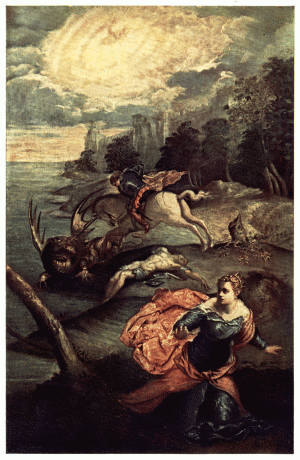
In the National Gallery we have three characteristic examples, fortunately on a smaller scale, namely, the S. George on a white horse, which, with its greyish flesh tones and the blue of the princess's mantle, is cooler in tone than the generality of his pictures; Christ washing the Disciples' Feet, and the very beautiful and radiant Origin of the Milky Way, purchased from Lord Darnley in 1890. At Hampton Court a still finer example, The Nine Muses, is so discoloured by age and hung in such a difficult light that it is impossible to enjoy its full beauty. art oil paintings
Paolo Caliari, better known as Veronese, was born ten years later than Tintoretto, and died six years before him (1528-1588). He studied in his native city of Verona till he was twenty, and after working for some time at Mantua he came to Venice in 1555, where he was quickly recognised by Titian and by Sansovino, the sculptor and Director of Public Buildings, and was commissioned in that year to paint aCoronation of the Virgin and other works in the church of S. Sebastian. The Martyrdom of S. Giustino, now in the Uffizi, and the Madonna and Child in the Louvre are also among his earlier works. As early as 1562 he was at work on the enormous Feast at Cana, now in the Louvre, and a similar work at Dresden is of the same date. In 1564 he went to Rome, where he studied the works of Raphael and Michelangelo. On his return to Venice in cheap oil paintings
cheap oil paintings
PLATE XVII.—TINTORETTO
ST GEORGE AND THE DRAGONNational Gallery, London

1565—after visiting Verona, where he painted in his parish church, and also married—he was employed to decorate the Ducal Palace, but much of his best work there was destroyed by fire. Two of his most important works completed before 1573 are in the Academy at Venice, The Battle of Lepanto and the Feast in the House of Levi. In this last he incurred strictures from the Inquisition more severe than those of Kugler upon Tintoretto's Last Supper, and possibly with as much reason, it being objected that the introduction of German soldiery, buffoons, and a parrot was "irreligious." His Family of Darius, now in the National Gallery, was one of his latest works. buy oil paintings online

Wednesday, March 12, 2014

The character and the influence

The character and the influence of Raphael are well expressed in the following sentences with which Vasari concludes his biography:—"O happy and blessed spirit! every one speaks with interest of thee; celebrates thy deeds; admires thee in thy works! Well might Painting die when this noble artist ceased to live; for when his eyes were closed she remained in darkness. For us who survive him it remains to imitate the excellent method which he has left for our guidance; and as his great qualities deserve,2 Pieces paintings, and our duty bids us, to cherish his memory in our hearts, and keep it alive in our discourse by speaking of him with the high respect which is his due. For through him we have the art in all its extent carried to a perfection which could hardly have been looked for; and in this universality let no human being ever hope to surpass him. And, beside this benefit which he conferred on Art as her true friend,cheap oil paintings, he neglected not to show us how every man should conduct himself in all the relations of life. Among his rare gifts there is one which especially excites my wonder; I mean, that Heaven should have granted him to infuse a spirit among those who lived around him so contrary to that which is prevalent among professional men. The painters—I do not allude to the humble-minded only, but to those of an ambitious turn, and many of this sort there are—the painters who worked in company with Raphael lived in perfect harmony,art oil paintings online, as if all bad feelings were extinguished in his presence, and every base, unworthy thought had passed from their minds.This was because the artists were at once subdued by his obliging manners and by his surpassing merit, but more than all by the spell of his natural character, which was so full of affectionate kindness, that not only men, but even the very brutes, respected him. He always had a great number of artists employed for him,abstract art oil paintings, helping them and teaching them with the kindness of a father to his children, rather than as a master directing his scholars. For which reason it was observed he never went to court without being accompanied from his very door by perhaps fifty painters who took pleasure in thus attending him to do him honour. In short, he lived more as a sovereign than as a painter. And thus, O Art of Painting! thou too, then, could account thyself most happy, since an artist was thine, who, by his skill and by his moral excellence exalted thee to the highest heaven!" oil paintings for sale online
Raphael was the son of Giovanni Sanzio, or di Santi, of Urbino. He received his first education as an artist from his father, whom, however, he lost in his eleventh year. As early as 1495 probably, he entered the school of Pietro Perugino, at Perugia, where he remained till about his twentieth year.

Tuesday, March 4, 2014

HEN we look into the past history

HEN we look into the past history of the present subject, the first German name we come upon is that of the Nun of Nuremberg, Sister Margareta, who worked from 1459 to 1470, and who copied many religious works. A century later, at Udina, in Italy, Irene von Spilimberg was born,2 Pieces paintings, descending from a noble German family; and although Irene died at the age of nineteen, she yet lived long enough to win the hearty admiration of her great master, Titian. As a picture by Irene von Spilimberg could not be obtained for this book, the editor has begun the German section with Anna Maria Schurman and with Maria Sibylla Merian. The first was a clever painter-etcher as well as the most learned lady of her time; the second was the daughter of Matthew Merian, and the exquisite studies she made, in water-colour, of insects and of plants and flowers, have never been excelled in their own line. art oil paintings for sale
From Maria Sibylla Merian (1647-1717) we pass on to an admirable mezzotint, after Morland, by Maria Prestel, who died in 1794; and then we are brought into the heart of the 19th century by the searching industry and skill of Anna Maria Ellenrieder, a very capable painter-etcher, who lived between the years 1791 and 1863. Ellenrieder looked to the past for her inspiration, going to the art of the early Dutch masters. She has little or nothing in common with the other German women artists of her time. How different is her ideal, for instance,art oil paintings online, from that of the well-known painter of historical subjects, the Baroness Hermione von Preuschen, whose dramatic and sensational spirit appeals so strongly to the great public, as in that canvas in which is represented the Corpse of Irene von Spilimberg, young and beautiful, lying in state in her Venetian gondola, draped with black and covered with flowers. Artists do not often care for pictures of this romantic type; and they find higher and more subtle qualities in the quiet wisdom of Julie Wolfthorn, a Berlin painter of note,abstract oil paintings, and a follower of the modern school of psychological portraiture. Julie Wolfthorn combines depth of feeling and refinement of taste with keenness of penetration into the mystery of individual character. Her portrait of a young sculptor, given in the illustration on page 304, is a good example of the painter's methods.

Another Berlin artist of note is Fräulein Käthe Kollwitz, whose principal field of artistic expression has hitherto been restricted to the burin and copper plate. She has studied etching almost entirely by herself, and by dint of persistent courage and skill has developed her gifts in a direction all her own. The subjects that appeal most forcibly to her mind are taken with scarcely an exception from the darkest and most painful sides of social life and social unrest. Take a glance at the father, mother,oil paints supplies, and child, reproduced on page 302, and entitled "Destitution and Despair." Are you not inclined to marvel, almost, how a woman had the courage to depict, without flinching, the sad truths of such bitter poverty? Can you not fancy that you hear the moan of misery, the shrill scream of starvation, the cries of rebellion and death, as when, on the outbreak of the strike, the bulk of the working classes casts itself upon the streets? Such masses in motion have been made real to us in her series of plates from the "Peasants' War." original oil paintings wholesale

Friday, February 28, 2014

The approach of the great national crisis

The approach of the great national crisis, and even the worst days of that period, at the same time glorious yet barbaric, did not extinguish the zeal of the women painters. It seems rather as though they shut themselves up in the study of their art so as to secure a refuge for their hopes and their dreams. In the first "Salons" of the century,2 Pieces paintings, one is surprised to find works by a comparatively large number of women painters. In 1800, of 180 exhibitors they number 25; eight years later, in the "Salon" of 1808, they are 46 out of 311. The difficulties set up by the Academy were overcome, the liberty to exhibit was a fresh encouragement, even an exceptional stimulus. The figures, therefore, rise still further in the first quarter of the century,abstract oil painting, so that in 1831 the women number 149 out of 873 exhibitors. The "staff," so to speak, of the women artists of that day, surrounding Mme. Vigée Le Brun, whose glorious and somewhat chequered career did not close till 1842, included a number of distinguished women, such as Mlle. Bevic and Mlle. Capet, pupils of Mme. Guyard; Mme. Chaudet, the wife of the sculptor; Mlle. Eulalie Morin; Mme. Adèle Romance, who also signed Romany, or Romany de Romance; the "good" Mlle. Godefroid,oil painting reproductions, pupil of Baron Gérard, who helped him in so many of the portraits of contemporary cosmopolitan people of distinction, commissions for which rained in the master's studio, after the entry of the allied forces into Paris. Later on, we have Mlle. Cogniet; Mme. Filleul; Mme. Rude, the wife of the great sculptor, who had a severe yet confident talent. Lastly, there was the woman artist who benefited by all the advantages of fashion, Mme. Haudebourt-Lescot. abstract art oil paintings
French School, 1755-1842
MADAME VIGÉE LE BRUN AND HER DAUGHTER.
AFTER THE PAINTING IN THE LOUVRE,
FROM A PHOTOGRAPH BY BRAUN, CLÉMENT & CO., PARIS
Madame Élisabeth Louise Vigée Le Brun, Painter
1755-1842

Mlle. Lescot, wife of Haudebourt, the architect, and pupil of Lethière—mischievous tongues, of course, declared that he painted her pictures—was a strange creature, who, at the start, owed the popularity she obtained as much to her personal charm as to her real talent. Her first success was in the drawing-room, where people admired her dances. "She was," says a writer, "ugly and captivating, with crooked eyes and a charming expression, her mouth ill-shaped, but tender and inviting," such as Ingres represented her in one of his finest pencil drawings. modern oil paintings

Tuesday, February 18, 2014

XXI. Bassano, Genre, and Landscape

Venetian painting would not have been the complete expression of the riper Renaissance if it had entirely neglected the country. City people have a natural love of the country, but when it was a matter of doubt whether a man would ever return if he ventured out of the town-gates, as was the case in the Middle Ages, this love had no chance of showing itself. It had to wait until the country itself was safe for wayfarers,2 Pieces paintings, a state of things which came about in Italy with the gradual submission of the country to the rule of the neighbouring cities and with the general advance of civilisation. During the Renaissance the love of the country and its pleasures received an immense impulse from Latin authors. What the great Romans without exception recommended, an Italian was not slow to adopt, particularly when,painting for sale, as in this case, it harmonised with natural inclination and with an already common practice. It was the usual thing with those who could afford to do so to retire to the villa for a large part of the year. Classic poets helped such Italians to appreciate the simplicity of the country and to feel a little of its beauty. Many took such delight in country life that they wished to have reminders of it in town. It may have been in response to some such half formulated wish that Palma began to paint his "Sante Conversazioni,canvas paintings for sale,"—groups of saintly personages gathered under pleasant trees in pretty landscapes. His pupil, Bonifazio, continued the same line, gradually, however, discarding the traditional group of Madonna and saints, and, under such titles as "The Rich Man's Feast" or "The Finding of Moses," painting all the scenes of fashionable country life, music on the terrace of a villa, hunting parties, and picnics in the forest. oil painting reproductions for sale
Bonifazio's pupil, Jacopo Bassano, no less fond of painting country scenes, did not however confine himself to representing city people in their parks. His pictures were for the inhabitants of the small market-town from which he takes his name, where inside the gates you still see men and women in rustic garb crouching over their many-coloured wares; and where, just outside the walls, you may see all the ordinary occupations connected with farming and grazing. Inspired, although unawares, by the new idea of giving perfectly modern versions of biblical stories, Bassano introduced into nearly every picture he painted episodes from the life in the streets of Bassano, and in the county just outside the gates. Even Orpheus in his hands becomes a farmer's lad fiddling to the barnyard fowls. wall art oil paintings

XIX. Venetian Art and the Provinces

The Venetian provinces were held together not merely by force of rule. In language and feeling no less than in government, they formed a distinct unit within the Italian peninsula. Painting being so truly a product of the soil as it was in Italy during the Renaissance,2 Pieces paintings, the art of the provinces could not help holding the same close relation to the art of Venice that their language and modes of feeling held. But a difference must be made at once between towns like Verona, with a school of at least as long a growth and with as independent an evolution as the school of Venice itself, and towns like Vicenza and Brescia whose chief painters never developed quite independently of Venice or Verona. What makes Romanino and Moretto of Brescia,original oil paintings, or even the powerful Montagna of Vicenza, except when they are at their very best, so much less enjoyable as a rule than the Venetians—that is to say the painters wholly educated in Venice,—is something they have in common with the Eclectics of a later day. They are ill at ease about their art, which is no longer the utterly unpremeditated outcome of a natural impulse. They saw greater painting than their own in Venice and Verona, and not unfrequently their own works show an uncouth attempt to adopt that greatness,art oil paintings online, which comes out in exaggeration of colour even more than of form, and speaks for that want of taste which is the indelible stamp of provincialism. But there were Venetian towns without the traditions even of the schools of Vicenza and Brescia, where, if you wanted to learn painting, you had to apprentice yourself to somebody who had been taught by somebody who had been a pupil of one of Giovanni Bellini's pupils. This was particularly true of the towns in that long stretch of plain between the Julian Alps and the sea, known as Friuli. Friuli produced one painter of remarkable talents and great force, Giovanni Antonio Pordenone, but neither his talents nor his force,abstract oil paintings for sale, nor even later study in Venice, could erase from his works that stamp of provincialism which he inherited from his first provincial master.
Such artists as these, however, never gained great favour in the capital. Those whom Venice drew to herself when her own strength was waning and when, like Rome in her decline, she began to absorb into herself the talent of the provinces, were rather painters such as Paolo Veronese whose art, although of independent growth, was sufficiently like her own to be readily understood, or painters with an entirely new vein, such as the Bassani. original oil paintings wholesale

Sunday, February 2, 2014

Sir David Wilkie (1785-1841) was also somewhat(BRITISH PAINTING)

Sir David Wilkie (1785-1841) was also somewhat like the Dutch in subject, a genre-painter, fond of the village fête and depicting it with careful detail, a limpid brush, and good textural effects. In 1825 he travelled abroad, was gone some years, was impressed by Velasquez, Correggio, and Rembrandt,2 Pieces paintings, and completely changed his style. He then became a portrait and historical painter. He never outlived the nervous constraint that shows in all his pictures, and his brush, though facile within limits, was never free or bold as compared with a Dutchman like Steen. In technical methods Landseer (1802-1873), the painter of animals,oil paintings for sale, was somewhat like him. That is to say, they both had a method of painting surfaces and rendering textures that was more "smart" than powerful. There is little solidity or depth to the brush-work of either, though both are impressive to the spectator at first sight. Landseer knew the habits and the anatomy of animals very well, but he never had an appreciation of the brute in the animal,cheap oil paintings, such as we see in the pictures of Velasquez or the bronzes of Barye. The Landseer animal has too much sentiment about it. The dogs, for instance, are generally given those emotions pertinent to humanity, and which are only exceptionally true of the canine race. This very feature—the tendency to humanize the brute and make it tell a story—accounts in large measure for the popularity of Landseer's art. The work is perhaps correct enough, but the aim of it is somewhat afield from pure painting. It illustrates the literary rather than the pictorial. Following Wilkie the most distinguished painter wasMulready (1786-1863), whose pictures of village boys are well known through engravings. abstract oil paintings for sale

FIG. 98.—TURNER. FIGHTING TÉMÉRAIRE. NAT. GAL. LONDON.
Please click here for a modern color image
THE LANDSCAPE PAINTERS: In landscape the English have had something to say peculiarly their own. It has not always been well said, the coloring is often hot, the brush-work brittle, the attention to detail inconsistent with the large view of nature, yet such as it is it shows the English point of view and is valuable on that account.Richard Wilson (1713-1782) was the first landscapist of importance,oil paintings, though he was not so English in view as some others to follow. In fact, Wilson was nurtured on Claude Lorrain and Joseph Vernet and instead of painting the realistic English landscape he painted the pseudo-Italian landscape. He began working in portraiture under the tutorship of Wright, and achieved some success in this department; but in 1749 he went to Italy and devoted himself wholly to landscapes. These were of the classic type and somewhat conventional. The composition was usually a dark foreground with trees or buildings to right and left,oil painting on canvas for sale, an opening in the middle distance leading into the background, and a broad expanse of sunset sky. In the foreground he usually introduced a few figures for romantic or classic association. Considerable elevation of theme and spirit marks most of his pictures. There was good workmanship about the skies and the light, and an attentive study of nature was shown throughout. His canvases did not meet with much success at the time they were painted. In more modern days Wilson has been ranked as the true founder of landscape in England, and one of the most sincere of English painters. abstract oil painting on canvas

Sunday, January 26, 2014

The whole academic tendency of modern painting(DUTCH PAINTING)


DUSSELDORF SCHOOL: After 1826 this school came into prominence under the guidance of Schadow. It did not fancy monumental painting so much as the common easel picture, with the sentimental, the dramatic, or the romantic subject. It was no better in either form or color than the Munich school, in fact not so good, though there were painters who emanated from it who had ability. At Berlin the inclination was to follow the methods and ideas held at Dusseldorf. 2 Pieces paintings
The whole academic tendency of modern painting in Germany and Austria for the past fifty years has not been favorable to the best kind of pictorial art. There is a disposition on the part of artists to tell stories, to encroach upon the sentiment of literature, to paint with a dry brush in harsh unsympathetic colors, to ignore relations of light-and-shade,oil paintings for sale, and to slur beauties of form. The subject seems to count for more than the truth of representation, or the individuality of view. From time to time artists of much ability have appeared, but these form an exception rather than a rule. The men to-day who are the great artists of Germany are less followers of the German tradition than individuals each working in a style peculiar to himself. A few only of abstract oil paintings for sale
[238] them call for mention. Menzel (1815-1905) is easily first, a painter of group pictures, a good colorist, and a powerful pen-and-ink draughtsman; Lenbach (1836-1904), a forceful portraitist;Uhde(1848-), a portrayer of scriptural scenes in modern costumes with much sincerity, good color, and light; Leibl (1844-1900), an artist with something of the Holbein touch and realism; Thoma, a Frankfort painter of decorative friezes and panels; LiebermannGotthardt KuehlFranz Stuck,Max KlingerGreinerTrübnerBartelsKellerart oil paintings for sale
MENZEL. A READER.
FIG. 93.—MENZEL. A READER.
Aside from these men there are several notable painters with German affinities, like Makart (1840-1884), an Austrian, who possessed good technical qualities and indulged in a profusion of color;Munkacsy (1846-1900), a Hungarian, who is perhaps more Parisian than German in technic, andBöcklin (1827-1901), a Swiss, who is quite by himself in fantastic and grotesque subjects, a weird and uncanny imagination, and a brilliant prismatic coloring. reproduction oil paintings for sale

SEVENTEENTH AND EIGHTEENTH CENTURIES(DUTCH PAINTING)


LEIBL. IN CHURCH.
SEVENTEENTH AND EIGHTEENTH CENTURIES: These were unrelieved centuries of decline in German painting. After Dürer, Holbein, and Cranach had passed there came about a senseless imitation of Italy, combined with an equally senseless imitation of detail in nature that produced nothing worthy of the name of original or genuine art. It is not probable that the Reformation had any more to do with this than with the decline in Italy. It was a period of barrenness in both countries. The Italian imitators in Germany were chiefly Rottenhammer(1564-1623),2 Pieces paintings, and Elzheimer (1574?-1620). After them came the representative of the other extreme inDenner (1685-1749), who thought to be great in portraiture by the minute imitation of hair, freckles, and three-days'-old beard—a petty and unworthy realism which excited some curiosity but never held rank as art. Mengs (1728-1779) sought for the sublime through eclecticism, but never reached it. His work, though academic and correct, is lacking in spirit and originality.Angelica Kauffman (1741-1807) succeeded in pleasing her inartistic age with the simply pretty, while Carstens (1754-1798) was a conscientious if mistaken student of the great Italians—a man of some severity in form and of academic inclinations. oil paintings for sale
NINETEENTH CENTURY: In the first part of this century there started in Germany a so-called "revival of art" led by Overbeck(1789-1869), Cornelius (1783-1867), Veit (1793-1877), andSchadow (1789-1862), but like many another revival of art it did not amount to much. The attempt to "revive" the past is usually a failure. The forms are caught, but the spirit is lost. The nineteenth-century attempt in Germany was brought about by the study of monumental painting in Italy, and the taking up of the religious spirit in a pre-Raphaelite manner. Something also of German romanticism was its inspiration. Overbeck remained in Rome, but the others, after some time in Italy,oil painting reproductions, returned to Germany, diffused their teaching, and really formed a new epoch in German painting. A modern art began with ambitions and subjects entirely disproportionate to its skill. The monumental, the ideal, the classic, the exalted, were spread over enormous spaces, but there was no reason for such work in the contemporary German life, and nothing to warrant its appearance save that its better had appeared in Italy during the Renaissance. Cornelius after his return became the head of the MUNICH SCHOOL and painted pictures of the heroes of the  where to buy oil paintings
MUNICH SCHOOL and painted pictures of the heroes of the classic and the Christian world upon a large scale. Nothing but their size and good intention ever brought them into notice, for their form and coloring were both commonplace. Schnorr (1794-1872) followed in the same style with the Niebelungen Lied, Charlemagne, and Barbarossa for subjects. Kaulbach (1805-1874) was a pupil of Cornelius, and had some ability but little taste, and not enough originality to produce great art.Piloty (1826-1886) was more realistic, more of a painter and ranks as one of the best of the early Munich masters. After him Munich art became genre-like in subject, with greater attention given to truthful representation in light, color, texture. To-day there are a large number of painters in the school who are remarkable for realistic detail.  oil paintings on canvas for sale

Thursday, January 23, 2014

Jan van der Meer of Delft-THE LANDSCAPE PAINTERS(DUTCH PAINTING)

Jan van der Meer of Delft (1632-1675), one of the most charming of all the genre painters, was allied to De Hooghe in his pictorial point of view and interior subjects. Unfortunately there is little left to us of this master, but the few extant examples serve to show him a painter of rare qualities in light, in color, and in atmosphere. He was a remarkable man for his handling of blues, reds, and yellows; and in the tonic relations of a picture he was a master second to no one. Fabritius is supposed to have influenced him. 2 Pieces paintings
THE LANDSCAPE PAINTERS: The painters of the Netherlands were probably the first, beginning with Bril, to paint landscape for its own sake, and as a picture motive in itself. Before them it had been used as a background for the figure, and was so used by many of the Dutchmen themselves. It has been said that these landscape-painters were also the first ones to paint landscape realistically,art oil paintings for sale,  but that is true only in part. They studied natural forms, as did, indeed, Bellini in the Venetian school; they learned something of perspective, air, tree anatomy, and the appearance of water; but no Dutch painter of landscape in the seventeenth century grasped the full color of Holland or painted its many varied lights. They indulged in a meagre conventional palette of grays, greens, and browns, whereas Holland is full of brilliant hues. oil painting reproductions for sale
HOBBEMA. THE WATER-WHEEL. AMSTERDAM MUS.
FIG. 84.—HOBBEMA. THE WATER-WHEEL. AMSTERDAM MUS.
Van Goyen (1596-1656) was one of the earliest of the seventeenth-century landscapists. In subject he was fond of the Dutch bays, harbors, rivers, and canals with shipping, windmills, and houses. His sky line was generally given low, his water silvery, and his sky misty and lumi nous with bursts of white light. In color he was subdued, and in perspective quite cunning at times. abstract oil paintings
Salomon van Ruisdael (1600?-1670) was his follower, if not his pupil. He had the same sobriety of color as his master, and was a mannered and prosaic painter in details, such as leaves and tree-branches. In composition he was good, but his art had only a slight basis upon reality, though it looks to be realistic at first sight. He had a formula for doing landscape which he varied only in a slight way, and this conventionality ran through all his work. Molyn (1600?-1661) was a painter who showed limited truth to nature in flat and hilly landscapes, transparent skies, and warm coloring. His extant works are few in number.  where to buy oil paintings
Wynants (1615?-1679?) was more of a realist in natural appearance than any of the others, a man who evidently studied directly from nature in details of vegetation, plants, trees, roads, grasses, and the like. Most of the figures and animals in his landscapes were painted by other hands. He himself was a pure landscape-painter, excelling in light and aërial perspective, but not remarkable in color. Van der Neer (1603-1677) and Everdingen(1621?-1675) were two other contemporary painters of merit. cheap oil paintings on canvas

The best landscapist following the first men of the century was Jacob van Ruisdael (1625?-1682), the nephew of Salomon van Ruisdael. He is put down, with perhaps unnecessary emphasis, as the greatest landscape-painter of the Dutch school. He was undoubtedly the equal of any of his time, though not so near to nature, perhaps, as Hobbema. He was a man of imagination, who at first pictured the Dutch country about Haarlem, and afterward took up with the romantic landscape of Van Everdingen. This landscape bears a resemblance to the Norwegian country, abounding, as it does,abstract paintings on canvas, in mountains, heavy dark woods, and rushing torrents. There is considerable poetry in its composition, its gloomy skies, and darkened lights. It is mournful, suggestive, wild, usually unpeopled. There was much of the methodical in its putting together, and in color it was cold, and limited to a few tones. Many of Ruisdael's works have darkened through time. Little is known about the painter's life except that he was not appreciated in his own time and died in the almshouse. original oil paintings wholesale