Showing posts with label As Seen and Described by Famous Writers. Show all posts

Sunday, November 17, 2013

Spring (BOTTICELLI) MARCEL REYMOND

Of all the ancient Italian painters, Botticelli has, for several years, been the master most in fashion. Why? The first reason should be sought in that reaction against the pseudo-classic style of the Renaissance which has seemed to be the dominant tendency of art in the Nineteenth Century. But this explanation does not suffice to tell us for what reasons the favour of the public has specially fallen upon Botticelli. Why select Botticelli rather than any other artist of the Fourteenth or Fifteenth Century? Why Botticelli and not Giotto, or Fra Angelico, or, to cite none but his contemporaries, why not Signorelli, or Ghirlandajo? It is because Fra Angelico's art is too religious for our century and Giotto's art too philosophical, or, at least, it is because our century no longer thinks of demanding from its artists, as in the time of Giotto and Fra Angelico, the expression of the moral questions with which it is occupied. And if we seem to-day somewhat indifferent to the art of Ghirlandajo, or Signorelli, it is because their thought is too grave and because we desire before all else that art shall bring smiles into our laborious life; we demand that it shall give repose to our tired brains by charming us with the vision of all terrestrial beauties, without exacting any labour or any effort from our minds. art oil paintings online
In this quest of beauty, our curious minds, which know so many things and which have been able to compare the works of the most diverse civilizations, are perpetually seeking novelty, eager for rare forms, and inimical to everything banal and to everything that ordinary life brings before our eyes. And in our fin de siècle we have been so much the more prone to subtle pursuits because for some time our French art has seemed to take delight in the forms of a gross realism.
This refinement of art, this intimate analysis of form and thought, this love of sensual beauty, had appeared at the court of the Medici by the same causes that prompt us to seek them; they are the fruit of a society that has attained the highest degree of well-being, wealth and knowledge. original oil paintings
This kind of art lasted only for a moment in Florence. It is correct to say that Florentine art did not seem destined to speak the charms of feminine beauty. From its beginning, this school had been stamped by Giotto with the philosophic impress, and for two centuries its artists had been before everything else, thinkers, occupied more with moral ideas than with the beauty of form.
The first in Florence to be enthralled by the charm of beautiful eyes was the poor Filippo Lippi. It was he who created that new form of art which was to continue with Botticelli, his pupil, and which attained its perfection under the hands of Leonardo. If, to the Lucrezia Buti of Filippo Lippi, we join Botticelli's Simonetta and Leonardo's Monna Lisa, we should have the poem of love sung by Florentine genius under its most exquisite form. art oil paintings for sale
Spring
Spring.
Botticelli.
What Botticelli was, Spring will tell us; and this work is so significant, its essence expresses the thought of the master so clearly that it has preserved all its charm for us, although its particular meaning is not known to us. We call it Spring, but if one of the figures in the picture really represents Spring, it is only an accessory figure; and, moreover, this name given to the picture is entirety modern. Vasari says that it represents Venus surrounded by the Graces, but if we find the three Graces in the picture, it is not likely that the principal figure represents Venus. In my opinion, it is that principal figure that is the key to the picture; it is for this figure that everything has been done, and this it is, above all, that we must interrogate if we wish to know Botticelli's meaning. Evidently it is neither Venus, nor Spring; and the precision of the features, and the fidelity of the smallest details of the costume make us believe that we are in the presence of a veritable portrait.... Around her, Nature adorns herself with flowers; Spring and the Graces surround her like a train of Fays. Here is one of the familiar poetical forms of the Fifteenth Century; and, doubtless, by attentively reading the Florentine poets, we should discover the meaning of all the allegorical figures that Botticelli has united in his work and which we do not understand.31 cheap oil paintings for sale
But whatever may be the particular meaning of each of316these figures, it is certain that here we have to do with love and beauty, and that perhaps in no other work may we find the charm of woman described in more passionate accents.
In this world of feminine fascination Botticelli loved everything. He knows the attraction of the toilet and of jewels, but he knows above all that no gem and no invention of man can rival the beauty of the female form. He was the first to understand the exquisite charm of silhouettes, the first to linger in expressing the joining of the arm and body, the flexibility of the hips, the roundness of the shoulders, the elegance of the leg, the little shadow that marks the springing of the neck, and, above all, the exquisite carving of the hand. But, even more, he understood "le prestige insolent des grands yeux,"—large eyes, full, restless, and sad, because they are filled with love. modern abstract art oil painting
Look at these young maidens of Botticelli's. What a heavenly vision! Did Alfred de Musset know these veiled forms that seem to float over the meadow and did he think of them in the sleeplessness of his nights of May? Did he think of that young girl whose arm rises supple as the stem of a flower, of that young Grace so charming in the frame of her fair hair confined by strings of pearls, or, indeed, of that Primavera, who advances so imperiously beautiful, in her long robe of brocade, scattering handfuls of flowers that she makes blossom, or of that young mother more charming still in her modest grace, with her beautiful eyes full of infinite tenderness.
And around this scene, what a beautiful frame of verdure and flowers! Nature has donned her richest festal317robes; the inanimate things, like the human beings, all speak of love and happiness, and tell us that the master of this world is that little child with bandaged eyes, who amuses himself by shooting his arrows of fire. large oil paintings for sale
To say a word about the technique of this work, we should remark that Botticelli always painted in fresco or distemper, and that he did not seek the supple modelling that painting in oil affords; and, on the other hand, he submitted profoundly to the influence of Pollaiolo; he observed Nature with the eyes of a goldsmith; and he painted his works as if, working a niello or enamel, he had to set each figure in gold-wire.
Finally, is it necessary to speak of the date of thePrimavera? This would occasion a long discussion if the space were accorded me. Let it suffice to say that the biography written by Vasari merits no credence, that it has been unfortunately accepted by the majority of historians, and that we have not yet a good chronology of Botticelli's works, nor even a simple catalogue. As for the chronology, most historians, relying upon Vasari, place nearly all of Botticelli's works before his trip to Rome in 1481. I think, on the contrary, and I will prove it elsewhere, that the great productive period of Botticelli belongs to the ten last years of the century and that the Primaverashould be classed in this period. The Primavera represents, with The Birth of Venus and The Adoration of the Magi, the culminating point of Botticelli's art. flower oil paintings on canvas
Jouin, Chefs-d'œuvre; Peinture, Sculpture, Architecture (Paris, 1895-97).

FOOTNOTES:

31 See notably the Stanze of Politian, where one will find nearly all the details of Botticelli's picture; the shady grove, the flowery meadow, even the attitudes and the garments of the personages. Is it not a figure of Botticelli's which is thus described:
"She is white and white is her robe,
All painted with flowers, roses, and blades of grass." wholesale oil paintings

The Fighting Téméraire TUGGED TO HER LAST BERTH TO BE BROKEN UP, 1838 (TURNER) JOHN RUSKIN

"The flag which braved the battle and the breeze
No longer owns her."
Exhibited at the Academy in 1839, with the above lines cited in the Catalogue. Of all Turner's pictures in the National Gallery this is perhaps the most notable. For, first it is the last picture he ever painted with perfect power—the last in which his execution is as firm and faultless as in middle life; the last in which lines requiring exquisite precision, such as those of the masts and yards of shipping, are drawn rightly at once. When he painted the Téméraire Turner could, if he liked, have painted the Shipwreck or the Ulysses over again; but when he painted the Sun of Venice, though he was able to do different, and in some sort more beautiful things, he could not have done those again. His period of central power thus begins with the Ulysses and closes with the Téméraire. The one picture, it will be observed, is of sunrise, the other of sunset. The one of a ship entering on its voyage, and the other of a ship closing its course for ever. The one, in all the circumstance of the subject, unconsciously illustrative of his own life in its triumph,oil paintings for sale, the other, in all the circumstances of its subject, unconsciously illustrative of his own life in its decline. Accurately as the first sets forth his escape to the wild brightness of nature, to reign amidst all her happy spirits, so does the last set forth his returning to die by the shore of the Thames. And besides having been painted in Turner's full power, theTéméraire is of all his large pictures the best preserved. Secondly, the subject of the picture is, both particularly and generally, the noblest that in an English National Gallery could be. The Téméraire was the second ship in Nelson's line at the Battle of Trafalgar; and this picture is the last of the group which Turner painted to illustrate that central struggle in our national history. The part played by theTéméraire in the battle will be found detailed below. And, generally, she is a type of one of England's chief glories. It will be always said of us, with unabated reverence, "They built ships of the line." Take it all in all, a Ship of the Line is the most honourable thing that man as a gregarious animal, has ever produced. By himself, unhelped,oil paintings, he can do better things than ships of the line; he can make poems and pictures, and other such concentrations of what is best in him. But as a being living in flocks, and hammering out, with alternate strokes and mutual agreement, what is necessary for him in those flocks, to get or produce, the ship of the line is his first work. And as the subject was the noblest Turner could have chosen so also was his treatment of it. Of all pictures of subjects not visibly involving human pain, this is, I believe, the most pathetic that was ever painted. The utmost pensiveness which can ordinarily be given to a landscape depends on adjuncts of ruin; but no ruin was ever so affecting as this gliding of the vessel to her grave. A ruin cannot be so, for whatever memories may be connected with it, and whatever witness it may have borne to the courage and glory of men, it never seems to have offered itself to their danger, and associated itself with their acts, as a ship of battle can. The mere facts of motion,art oil paintings for sale, and obedience to human guidance, double the interest of the vessel: nor less her organized perfectness, giving her the look, and partly the character of a living creature, that may indeed be maimed in limb or decrepit in frame, but must either live or die, and cannot be added to nor diminished from—heaped up and dragged down—as a building can. And this particular ship, crowned in the Trafalgar hour of trial with chief victory—prevailing over the fatal vessel that had given Nelson death—surely, if ever anything without a soul deserved honour or affection, we owed them here. Those sails that strained so full bent into the battle—that broad bow that struck the surf aside, enlarging silently in steadfast haste full front to the shot—resistless and without reply—those triple ports whose choirs of flame rang forth in their courses, into the fierce revenging monotone, which, when it died away, left no answering voice to rise any more upon the sea against the strength of England—those sides that were wet with the long runlets of English life-blood, like press planks at vintage, gleaming goodly crimson down to the cast and clash of the washing foam—those pale masts that stayed themselves up against the war-ruin, shaking out their ensigns through the thunder, till sail and ensign drooped—steeped in the death-stilled pause of Andalusian air, burning with its witness-clouds of human souls at rest,—surely, for these some sacred care might have been left in our thoughts,original oil paintings, some quiet space amidst the lapse of English waters? Nay, not so. We have stern keepers to trust her glory to—the fire and the worm. Never more shall sunset lay golden robe on her, nor starlight tremble on the waves that part at her gliding. Perhaps, where the low gate opens to some cottage-garden, the tired traveller may ask, idly, why the moss grows so green on its rugged wood; and even the sailor's child may not answer, nor know, that the night-dew lies deep in the war-rents of the wood of the old Téméraire. And, lastly, the pathos of the picture—the contrast of the old ship's past glory with her present end; and the spectacle of the "old order" of the ship of the line whose flag had braved the battle and the breeze, yielding place to the new, in the little steam-tug—these pathetic contrasts are repeated and enforced by a technicaltour de force in the treatment of the colours which is without a parallel in art. And the picture itself thus combines the evidences of Turner's supremacy alike in imagination and in skill. The old masters, content with one simple tone,oil painting reproductions,sacrificed to its unity all the exquisite gradations and varied touches of relief and change by which nature unites her hours with each other. They gave the warmth of the sinking sun, overwhelming all things in its gold, but they did not give those gray passages about the horizon, where, seen through its dying light, the cool and the gloom of night gather themselves for their victory.... But in this picture, under the blazing veil of vaulted fire, which lights the vessel on her last path, there is a blue, deep, desolate hollow of darkness out of which you can hear the voice of the night wind, and the dull boom of the disturbed sea; the cold deadly shadows of the twilight are gathering through every sunbeam, and moment by moment, as you look, you will fancy some new film and faintness of the night has risen over the vastness of the departing form. (Compiled from Modern Painters, Vol. I. pt. ii. Sec. I. ch. vii. § 46 n., Sec. II. ch i. § 21; Harbours of England, p. 12; and Notes on the Turner Gallery, pp. 75-80.) cheap oil paintings
The Fighting Téméraire
The Fighting Téméraire.
Turner.
Finally a few words about the history of the picture itself may be interesting. The subject of it was suggested to Turner by Clarkson Stanfield (who himself, it will be remembered, had painted a Battle of Trafalgar). They were going down the river by boat, to dine, perhaps, at Greenwich, when the old ship, being tugged to her last berth at Deptford, came in sight. "There's a fine subject, Turner," said Stanfield. This was in 1838. Next year the picture was exhibited at the Academy, but no price was put upon it. A would-be purchaser offered Turner 300 guineas for it. He replied that it was his "200 guinea size" only, and offered to take a commission at that price for any subject of the same size, but with theTéméraire itself he would not part. Another offer was subsequently made from America, which again Turner declined. He had already mentally included the picture, it would seem, amongst those to be bequeathed to the nation; and in one of the codicils to his will, in which he left each of his executors a picture to be chosen by them in turn,311the Téméraire was specially excepted from the pictures they might choose.30 art oil painting reproduction
Edward T. Cook, A Popular Handbook to the National Gallery.

FOOTNOTES:

30 Mr. W. Hale White recently drew up for Mr. Ruskin, from official records, the following history of the Téméraire. To him and to Mr. Ruskin I am indebted for permission to insert the history here. It will be seen that Turner was right in calling his picture the Fighting Téméraire and the critic who induced him to change the title in the engraving to the Old Téméraire wrong:—
"The Téméraire, second-rate, ninety-eight guns, was begun at Chatham, July, 1793, and launched on the 11th September, 1798. She was named after an older Téméraire taken by Admiral Boscawen from the French in 1759, and sold in June, 1784. The ChathamTéméraire was fitted at Plymouth for a prison ship in 1812, and in 1819 she became a receiving ship and was sent to Sheerness. She was sold on the 16th August, 1838, to Mr. J. Beatson for £5,530. The Téméraire was at the Battle of Trafalgar on the 21st October, 1805. She was next to the Victory, and followed Nelson into action; commanded by Captain Elias Harvey, with Thomas Kennedy as first lieutenant. Her maintopmast, the head of her mizzenmast, her foreyard, her starboard, cathead and bumpkin,buy oil paintings online, and her fore and main topsail yards were shot away; her fore and main masts so wounded as to render them unfit to carry sail, and her bowsprit shot through in several places. Her rigging of every sort was cut to pieces; the head of her rudder was taken off by the fire of the Redoutable; eight feet of the starboard side of the lower deck abreast of the mainmast were stove in, and the whole of her quarter-galleries on both sides carried away. Forty-six men on board of her were killed, and seventy-six wounded.... The Téméraire was built with a beakhead, or, in other words, her upper works were cut off across the catheads; a peculiarity which can be observed in Turner's picture. It was found by experience in the early part of the French war that this mode of construction exposed the men working the guns to the enemy's fire, and it was afterwards abandoned. It has been objected," adds Mr. White, "that the masts and yards in the picture are too light for a ninety-eight gun ship; but the truth is that when the vessel was sold she was juryrigged as a receiving ship, and Turner, therefore, was strictly accurate. He might have seemed more accurate by putting heavier masts and yards in her; but he painted her as he saw her. This is very important, as it gets rid of the difficulty which I myself have felt and expressed, that it was very improbable that she was sold all standing in sea-going trim, as I imagined Turner intended us to believe she was sold, and answers also the criticism just mentioned as to the disproportion between the weight of the masts and yards and the size of the hull." Part of the Téméraire, Mr. White tells me, is still in existence. Messrs. Castle, the shipbuilders of Millbank, have the two figures of Atlas which supported the sterngallery. wall art oil paintings

Portrait of the Children of Charles I. (VAN DYCK) JULES GUIFFREY

Upon his arrival [in England] Anthonius was temporarily lodged at the house of Edward Norgate, aprotégé of the Earl of Arundel, charged by the King to provide for all the needs of his guest. Another such installation could not be repeated. The sovereign himself took pains to find a suitable establishment for his painter. Mr. Carpenter cites a very curious note on this subject. Charles I. wrote with his own hand,—"To speak with Inigo Jones concerning a house for Vandike." This house demanded the combination of certain conditions very difficult to meet with. It was necessary that the artist should be comfortably established; and, on the other hand, the King wished him not to be too far from the palace. The architect was able to satisfy all these requirements. A winter residence was found for Van Dyck in Blackfriars on the right bank of the Thames. From his palace in Whitehall,decorative paintings, Charles I., crossing the river in his barge, could conveniently reach the studio of his favourite painter. He took great pleasure in watching him at work and loved to forget himself during the long hours charmed by the wit and innate distinction of his entertainer. During the summer season, Van Dyck lived at Eltham in the county of Kent. He probably occupied an apartment or some dependency of one of the palaces of the Crown. An annual pension of two hundred pounds sterling was assigned to him, first of all to enable him to support a household worthy of the title bestowed upon him,—"Principal Painter in Ordinary." The portraits commanded by the King were paid for independently. The remuneration for his works finally provided the artist with that brilliant and gorgeous life which had been his ambition for so long and which an assiduous industry had not been able to procure for him in Flanders. He had no less than six servants and several horses; at all periods, as we know, he always bestowed much care and refinement upon his toilet. Frequenting an elegant and frivolous court could not but develop this natural disposition for all the quests of luxury. oil paintings for sale
Portrait of the Children of Charles I.
Van Dyck.
Three months after his arrival, Van Dyck was included in a creation of knights made on July 5, 1632. Charles I. added still more to this favour by the gift of a chain of gold bearing a miniature of himself enriched with diamonds. In many of his portraits the artist is represented with this mark of royal munificence.
It now devolved upon him to justify the high position to which he found himself so rapidly elevated. An act of the Privy Seal pointed out by Mr. Carpenter shows us that Van Dyck lost no time in satisfying the impatience of his royal protector. On August 8, 1632, the sum of£224 was allowed him from the royal treasury for various works of painting. The enumeration of these pictures furnishes precious details for the price of the artist's works.It seems that from the very beginning,art oil paintings online, a kind of tariff was adopted with common accord, according to the size of each portrait. The price of a whole length portrait was £25; other canvases only fetched £20; that refers probably to personages at half length. Finally, a large family picture, representing the King, the Queen, and their two children attained the sum of £100. At a later period, these figures were increased and the price of a full length portrait was raised to £40.
But how many of these works, in which, however, very great qualities shine, pale before a canvas of the Master preserved in the Museum of Turin! We mean the picture in which the three young children of Charles I. are grouped—the Prince of Wales, the Princess Henrietta Maria who became the Duchess of Orleans, and the Duke of York. All three are still in long dresses, therefore the eldest was about five or six years old at most; all three are standing up, and for that reason we cannot give the youngest less than eighteen months or two years. This circumstance dates the picture—it was painted in 1635. cheap oil paintings
We know the various portraits of the children of Charles I. disseminated in the museums and palaces of Europe; we have seen and admired the picture in Dresden, those at Windsor, the sketch in the Louvre, and the canvas in Berlin, a copy of the great composition which belongs to the Queen of England. Very well! there is not the slightest hesitation possible—not one of these pictures is comparable to that in Turin. Nowhere does there exist a work of Van Dyck's so delicate, so well preserved, and so perfect in all its points. With what care and worship this303picture is surrounded no one can imagine. The most watchful precautions and the most respectful regard are at its service. We have been told that the directors of the Museum constantly refuse to move it for the convenience of photographers. A little detail hardly worth mentioning, one would say! We do not think so. We consider that the authorities of the Museum are right a thousand times, when they possess such a chef-d'œuvre, not to neglect any precaution, however insignificant it may appear, to assure it a longer duration.
A fine engraving of this incomparable jewel gives a very exact idea of the arrangement and dominating qualities of the picture; but how can we translate in black and white the shimmering of material, the delicacy of tone, the colouring of those robes, rose, blue, and white, of exquisite harmony and incomparable finesse. abstract oil paintings
What shall we say of the physiognomy, of the grace, and also the penetrating charm of those three child figures? Such a work would alone suffice for the glory of a museum, above all when it has kept its freshness like the flowering of genius.
Every moment of the painter was consecrated to the various members of the royal family. That was natural enough. Charles I. never desisted from watching his clever protégé at work, and spending his leisure in his studio,—the habitual rendez-vous of the young gentlemen and the beauties of fashion. The establishment of the artist permitted him to receive such guests becomingly. Hired musicians were instructed to divert his aristocratic models during the hours of work. Thus he was enabled to attract and hold at his home the very best society in London. Every day at his table sat numerous guests chosen from the élite of the artists and littérateurs mingled with the greatest personages. Carried into the whirlwind of this light world so full of entertainment, Van Dyck hastened to enjoy all the pleasures and exhaust all the delights, without considering his strength, or hoarding his health.... oil paintings for sale cheap
The King would never let him stop painting the pictures of his children. On his side, Van Dyck brought to this task all his art, we might say all his heart. Doubtless, he derived from Rubens and also from Van Balen that very lively intelligence for the graces of childhood. Also, when he occupied himself in rendering those delicious faces of rosy and chubby babies, in the midst of glimmering stuffs, he found colours of incomparable freshness....
Every artist of high degree carries within himself the ideal type whose expression he pursues without pause. This search imprints upon each of his works the characteristic mark of genius: originality. Thus we recognize at the first glance the giants that sprang from the brain of Michael Angelo, the enigmatical sirens of da Vinci, and those superhuman figures with which Raphael has peopled his immortal compositions. Titian lived in a world of kings and magnificent princes. Correggio's individuality is grace of form and charm of colour; his portion is not to be scorned. The exuberant nature of Rubens betrays itself in his least important canvases. The personages of his innumerable pictures share in common the affinities of race and family which make them recognizable everywhere.
Anthonius Van Dyck obeys, likewise, the common law. Each 305of his works is marked by that sign of originality, which in him consists of the incessant pursuit of elegance and distinction. Distinction,—that is the gift par excellence, the dominating quality of this artist, that which constitutes his individuality, that which marks with an indelible imprint all his glorious works, from the first gropings of the pupil of Rubens to those immortal images of Charles I., his family, and his court. original oil paintings for sale
Whether he belongs to the highest spheres of society or whether he comes from the simple bourgeoisie of Antwerp, the model receives from Van Dyck's brush the most aristocratic mien. One would insist that the painter spent his life only in a world of gentlemen and patricians. Never does he surprise even the men that he knows the best, his most intimate friends, in the familiar carelessness of their daily occupations. Rarely, very rarely, does it come into his mind to group them in some intimate interior scene. Everybody is made to pose before posterity; each sitter has the smile to give his or her descendants the most exalted idea of his or her station and manners. Not one is vulgar, not one dares to show himself in his ordinary work, or in the careless good nature of daily life. Nothing alters their immutable serenity; nothing troubles the unalterable placidity of their physiognomy. Let others paint the people of taverns, the world of kermesses and peasants! Van Dyck wished to be and to live for ever the painter of aristocracy.

Antoine Van Dyck—sa vie et sonnœuvre. (Paris, 1882). original oil paintings wholesale

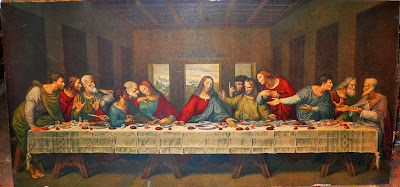
The Last Supper (LEONARDO DA VINCI) JOHANN WOLFGANG VON GOETHE

We will now turn to The Last Supper, which was painted on the wall of the refectory of St. Maria delle Gratie in Milan.
The place where this picture is painted must first be considered: for here the knowledge of this artist is focussed. Could anything more appropriate, or noble, be devised for a refectory than a parting meal which the whole world will reverence for ever? decorative paintings
Several years ago when travelling we beheld this dining-room still undestroyed. Opposite the entrance on the narrow end on the floor of the hall stands the prior's table with a table for the monks on either side, all three raised a step above the ground, and now when the visitor turns around he sees painted on the wall, above the not very high doors, a fourth table, at which are seated Christ and His disciples, as if they also belonged to this company. It must have been an impressive sight at meal times when the tables of Christ and the prior looked upon each other like two pictures, and the monks found themselves enclosed between them. And, for this very reason, the artist's judgment selected the tables of the monks for a model. Also the table-cloth, with its creased folds, embroidered stripes, and tied corners, was taken from the linen-room of the monastery, while the dishes, plates, drinking-vessels, and other utensils are similarly copied from those used by the monks. oil paintings for sale
The Last Supper
The Last Supper.
L. da Vinci.
Here, also, no attempt was made to depict an uncertain and antiquated custom. It would have been extremely unsuitable in this place to permit the holy company to recline upon cushions. No! it should be made contemporary. Christ should take His Last Supper with the Dominicans in Milan.
In many other respects also the picture must have produced a great effect. About ten feet above the floor the thirteen figures, each one half larger than life-size, occupy a space twenty-eight Parisian feet long. Only two of these can be seen at full length at the opposite ends of the table, the others are half-figures, and here, too, the artist found great advantage in the conditions. Every moral expression belongs solely to the upper part of the body, and the feet, in such cases, are always in the way; the artist has created here eleven half-figures, whose laps and knees are hidden by the table and table-cloth under which the feet in the deep shadow are scarcely visible. cheap oil paintings
Now, let us transport ourselves to this place and room, imagine the extreme moral repose which reigns in such a monastic dining-hall, and marvel at the strong emotion and impassioned action that the painter has put into his picture whilst he has kept his work of art close to nature, bringing it immediately in contrast with the neighbouring actual scene.
The exciting means which the artist employed to agitate the tranquil and holy Supper-Table are the Master's words: "There is one amongst you that betrays me." The words are spoken, and the entire company falls into consternation; but He inclines His head with downcast looks; the whole attitude, the motion of the arms, the hands, and everything repeat with heavenly resignation which the silence itself confirms, "Verily, verily, there is one amongst you that betrays Me." oil paintings
Before going any farther we must point out a great expedient, by means of which Leonardo principally animated this picture: it is the motion of the hands; only an Italian would have discovered this. With his nation the whole body is expressive, all the limbs take part in describing an emotion, not only passion but also thought. By various gestures he can express: "What do I care?"—"Come here!"—"This is a rascal, beware of him!" "He shall not live long!" "This is a main point. Take heed of this, my hearers!" To such a national trait, Leonardo, who observed every characteristic with the greatest attention, must have turned his searching eye; in this the present picture is unique and one cannot observe it too much. The expression of every face and every gesture is in perfect harmony, and yet a single glance can take in the unity and the contrast of the limbs rendered so admirably. paintings for sale
The figures on both sides of our Lord may be considered in groups of three, and each group may be regarded as a unit, placed in relation and still held in connection with its neighbours. On Christ's immediate right are John, Judas, and Peter.
Peter, the farthest, on hearing the words of our Lord, rises suddenly, in conformity with his vehement character, behind Judas, who, looking up with terrified countenance, leans over the table, tightly clutching the purse with his right hand, whilst with the left he makes an involuntary nervous motion as if to say: "What may this mean? What is to happen?" Peter, meanwhile, with his left hand has seized the right shoulder of John, who is bending towards him, and points to Christ, at the same time urging the beloved disciple to ask: "Who is the traitor?" He accidentally touches Judas's side with the handle of a knife held in his right hand, which occasions the terrified forward movement upsetting the salt-cellar, so happily brought out. This group may be considered as the one first thought of by the artist; it is the most perfect. buy oil paintings online
While now on the right hand of the Lord a certain degree of emotion seems to threaten immediate revenge, on the left, the liveliest horror and detestation of the treachery manifest themselves. James the Elder starts back in terror, and with outspread arms gazes transfixed with bowed head, like one who imagines that he already beholds with his eyes what his ears have heard. Thomas appears behind his shoulder, and approaching the Saviour raises the forefinger of his right hand to his forehead. Philip, the third of this group, rounds it off in the most pleasing manner; he has risen, he bends forward towards the Master, lays his hands upon his breast, and says with the greatest clearness: "It is not I, Lord, Thou knowest it! Thou knowest my pure heart, it is not I." where to buy oil paintings
And now the three last figures on this side give us new material for reflection. They are discussing the terrible news. Matthew turns his face eagerly to his two companions on the left, hastily stretching out his hands towards the Master, and thus, by an admirable contrivance of the artist, he is made to connect his own group with the preceding one. Thaddæus shows the utmost surprise, doubt, and suspicion; his left hand rests upon the table, while he has raised the right as if he intended to strike his left hand with the back of his right, a very common action with simple people when some unexpected occurrence leads them to say: "Did I not tell you so? Did I not always suspect it?"—Simon sits at the end of the table with great dignity, and we see his whole figure; he is the oldest of all and wears a garment with rich folds, his face and gesture show that he is troubled and thoughtful but not excited, indeed, scarcely moved. reproduction oil paintings uk
If we now turn our eyes to the opposite end of the table, we see Bartholomew, who rests on his right foot with the left crossed over it, supporting his inclined body by firmly resting his hands upon the table. He is probably trying to hear what John will ask of the Lord: this whole side appears to be inciting the favourite disciple. James the Younger, standing near and behind Bartholomew, lays his left hand on Peter's shoulder, just as Peter lays his on John's shoulder, but James mildly requests the explanation whilst Peter already threatens vengeance.
And as Peter behind Judas, so James the Younger stretches out his hand behind Andrew, who, as one of the most prominent figures expresses, with his half-raised arms and his hands stretched out directly in front, the fixed horror that has seized him, an attitude occurring but once in this picture, while in other works of less genius and less reflection, it is too often repeated.... abstract art oil paintings
It is sad to reflect that unfortunately even when the picture was painted, its ruin might have been predicted from the character and situation of the building. Duke Louis, out of malice or caprice, compelled the monks to renovate their decaying monastery in this unfavourable location, wherefore it was ill-built and as if by forced feudal labour. In the old galleries we see miserable meanly-wrought columns, great arches with small ill-assorted bricks, the materials from old pulled-down buildings. original oil paintings for sale
If then what is visible on the exterior is so bad, it is also to be feared that the inner walls, which were plastered over, were constructed still worse. This is saying nothing of weather-beaten bricks and other minerals saturated with hurtful salts which absorbed the dampness of the locality and destructively exhaled it again. Farther away stood the unfortunate walls to which such a great treasure was entrusted, towards the north, and, moreover in the vicinity of the kitchen, the pantry, and the scullery; and how sad, that so careful an artist, who could not select and refine his colours and clear his glaze and varnish too carefully, was compelled by the circumstances, or rather by the place and situation in which the picture had to stand, to overlook the chief point upon which everything depended, or not to take it sufficiently to heart! original oil paintings wholesale
However, despite all this, if the monastery had stood upon high ground, the evil would not have been so great. It lies so low, and the Refectory lower than the rest of the building, that in the year 1800, during a long rain, the water stood to a depth of three palms, which leads us also to believe that the frightful floods of 1500 also extended to this place. It is to be remembered that the monks did their best to dry out this room, but unfortunately there remained enough humidity to penetrate it through and through; and they were even sensible of this in Leonardo's time. oil painted portraits
About ten years after the completion of the picture, a terrible plague overran the good city, and how could we expect that the afflicted monks, forsaken by all the world and in fear of death, should think of the picture in their dining-room?
War and numerous other misfortunes which overtook Lombardy in the first half of the Sixteenth Century were the cause of the complete neglect of such works as the one we are speaking of; the white-washed wall being especially unfavourable: perhaps, indeed, the very style of painting lent itself to speedy destruction. In the second half of the Sixteenth Century a traveller says that the picture is half spoiled; another sees in it only a tarnished blot; people complain that the picture is already lost, assuredly it can scarcely be seen; another calls it perfectly useless, and so speak all the later authors of this period. oil paintings for sale online
But the picture was still there, even if it was the shadow of its former self. Now, however, from time to time fear arises lest it be lost entirely; the cracks are increasing and run into one another, and the great and precious surface is splitting into numberless small flakes and threatening to fall piece by piece. Touched by this state of affairs, Cardinal Frederick Borromeo had a copy of it made in 1612, and we are grateful for his forethought.
Not only did it suffer by the lapse of time, in connection with the above-mentioned circumstances, but the owners, themselves, who should have kept and preserved it, wrought its greatest ruin and therefore have covered their memory with eternal shame. It seemed to them necessary to have doors that they might pass in and out of the Refectory; so these were cut symmetrically through the wall upon which the picture stood. They desired an impressive entrance into the room which was so precious to them. wholesale oil paintings
A door much larger than was necessary was broken through the middle, and, without any feeling of reverence either for the painter or the holy company, they ruined the feet of several apostles, indeed, even of Christ. And from this, the ruin of the picture really dates. Now, in order to build an arch, a much larger opening had to be made in the wall than even for the door; and not only was a large portion of the picture lost, but the blows of hammers shook the picture in its own field, and in many places the crust was loosened and some pieces were fastened on again with nails. oil paintings of italy
At a later period, by a new form of bad taste, the picture was obscured, inasmuch as a national escutcheon was fastened under the ceiling, almost touching the forehead of Christ; thus by the door from below, so now from above also, the Lord's presence was cramped and degraded. From this time forward the restoration was again spoken of which was undertaken at a later period. But what real artist would care to undertake such a responsibility? Unfortunately, in the year 1726, Bellotti presented himself, poor in art, but at the same time, as is usual, with an abundant supply of presumption. He, like a charlatan, boasted of a secret process with which he could restore the picture to its original state. By means of a small sample of his work he deluded the ignorant monks who yielded to his discretion this treasure, which he immediately surrounded with scaffolding, and, hidden behind it, he painted over the entire picture with a hand shaming to art. The little monks wondered at the secret, which he communicated in a common varnish to delude them, and gave them to understand that with this they would be able to save it from spoiling for ever. wholesale oil paintings
Whether, on the clouding of the picture after a short time, the monks made use of this costly remedy or not, is unknown, but it certainly was freshened up several times, and indeed with water-colours in certain parts.
Meanwhile the picture had become constantly more decayed, and again the question arose how far it could still be preserved, but not without much contention among artists and directors. De Giorgi, a modest man of moderate talent, but intelligent and zealous and with a knowledge of true art, steadfastly refused to set his hand forward where Leonardo had withheld his own.
At last, in 1770, on a well-meaning order but one void of discretion, through the indulgence of a courtly prior, the work was transferred to a certain Mazza, who botched it in a masterly manner. The few old original spots remaining, although twice muddied by a foreign hand, were an impediment to his free brush; so he scraped them with iron and prepared bare places for the free play of his own impudent daubing, indeed, several heads were handled in this way. oil paintings for sale online
Friends of art were now aroused against that in Milan, and patrons and clients were openly blamed. Enthusiasm fed the fire and the fermentation became general. Mazza, who had begun to paint on the right of the Saviour, had by this arrived at the left, and only the heads of Matthew, Thaddæus, and Simon remained untouched. He thought to cover Bellotti's work and to vie with him in the name of a hero. But Fate willed otherwise, for the pliant prior having been transferred, his successor, a friend of art, did not delay to dismiss Mazza forthwith; through which step three heads were so far saved that we can accordingly judge of Bellotti. And, indeed, this circumstance probably gave rise to the saying: "There are still three heads of the genuine original remaining."
In 1796, the French host crossed the Alps triumphantly, led by General Bonaparte. Young, crowned with fame and seeking fame, he was drawn by the name of Leonardo to the place that has now held us so long.
He immediately gave orders that no encampment should be made here lest other damage should happen, and signed the order on his knee before he mounted his horse. Shortly afterwards another general disregarded these orders, had the doors broken in, and turned the hall into a stable. oil paintings for sale online
Mazza's coating had already lost some of its freshness and the horse steam which was worse than the steam from viands on monkish sideboards lastingly impregnated the walls, and added new mould to the picture; indeed, dampness collected so heavily that it ran down leaving white streaks. Later, this room was used for storing hay, and sometimes for other purposes connected with the military, by whom it was abused.
Finally the Administration succeeded in closing the place, and even walling it in, so that for a long time those who wished to see The Last Supper were obliged to climb a ladder leading to the pulpit from which the Reader discoursed at meal times. large oil paintings on canvas
In the year 1800, a great flood produced still more dampness. In 1801, on the recommendation of Vossi, who took it upon himself to assume the Secretaryship of the Academy, a door was built and the board of governors promised more care in the future. Finally, in 1807, the Viceroy of Italy gave orders that the place should be renovated and duly honoured. Windows were put in and scaffolding was erected in some parts to examine if there was anything more that could be done. The door was transferred to the side, and since then no considerable changes have been noticed, although to the minute observer its dullness varies according to the state of the atmosphere. Although the work itself is as good as lost, may it yet leave some slight trace to the sad but pious memory of future generations!

Werke (Stuttgart and Tübingen, 1831), Vol. XXXIX.  oil paintings on canvas for sale
St. Cecilia (RAPHAEL) PERCY BYSSHE SHELLEY

I have seen a quantity of things here—churches, palaces, statues, fountains, and pictures; and my brain is at this moment like a portfolio of an architect, or a print-shop, or a common-place book. I will try to recollect something of what I have seen; for indeed it requires, if it will obey, an act of volition. First, we went to the Cathedral, which contains nothing remarkable, except a kind of shrine, or rather a marble canopy, loaded with sculptures, and supported on four marble columns. We went then to a palace—I am sure I forget the name of it—where we saw a large gallery of pictures. Of course, in a picture gallery you see three hundred pictures you forget, for one you remember. I remember, however, an interesting picture by Guido, of the Rape of Proserpine, in which Proserpine casts back her languid and half-unwilling eyes, as it were, to the flowers she had left ungathered in the fields of Enna. decorative paintings
We saw besides one picture of Raphael—St. Cecilia; this is in another and higher style; you forget that it is a picture as you look at it; and yet it is most unlike any of those things which we call reality. It is of the inspired and ideal kind, and seems to have been conceived and executed in a similar state of feeling to that which produced among the ancients those perfect specimens of poetry and sculpture which are the baffling models of succeeding generations. There is a unity and a perfection in it of an incommunicable kind. The central figure, St. Cecilia, seems rapt in such inspiration as produced her image in the painter's mind; her deep, dark, eloquent eyes lifted up; her chestnut hair flung back from her forehead—she holds an organ in her hands—her countenance, as it were, calmed by the depth of its passion and rapture, and penetrated throughout with the warm and radiant light of life. She is listening to the music of heaven, and, as I imagine, has just ceased to sing, for the four figures that surround her evidently point, by their attitudes, towards her; particularly St. John, who, with a tender yet impassioned gesture, bends his countenance towards her, languid with the depth of his emotion. At her feet lie various instruments of music, broken and unstrung. Of the colouring I do not speak; it eclipses nature, yet has all her truth and softness. oil paintings for sale
Letters from Italy. The Prose Works of Percy Bysshe Shelley, edited by Harry Buxton Forman (London, 1880).

St. Cecilia.
Raphael.

Portrait of Lady Cockburn and her Children (REYNOLDS) FREDERIC G. STEPHENS

The number of Reynolds's portraits of ladies has never been given, probably it cannot be ascertained with precision; it is beyond all question marvellous, but not less so is the variety of the attitudes in which he placed the sitters, that of the ideas he expressed, and of the accessories with which they are surrounded; to this end, and to show how successfully he fitted things together, background and figure, compare the portrait of Elizabeth Hamilton, Countess of Derby splendidly engraved by W. Dickinson, with that of Lady Betty Delmé. It is the same everywhere. oil paintings for sale
We believe that Reynolds, of that English school of portrait-painters of which he was the founder, was the happiest in introducing backgrounds to his works; to him we are for the most part indebted for that aptitude of one to the other which has so great an effect in putting the eye and mind of the observer into harmonious relationship with what may be called the motive of the portrait, which, indeed, elevates a mere likeness to the character of a picture, and affords a charming field for the display of art in pathos, which is too often neglected, if not utterly ignored, by Reynolds's successors. We think he exhibited more of this valuable characteristic than any other contemporary artist. Lawrence aimed at it, but with effect only commensurate to his success in painting. Of old, as before the Seventeenth Century in Germany and Italy, the art of landscape-painting per se was inefficiently cultivated, at least expressed with irregularity, although occasionally with force enough to show that the pathos as well as the beauty of nature were by no means unappreciated or neglected to anything like the extent which has been commonly represented by writers on Art. Reynolds probably took the hint, as he did many others of the kind, from Vandyck, and gave apt backgrounds to his figures: between these painters no one did much, or even well in the pathetic part of the achievement. Since Reynolds, none have approached him in success. It will be understood that the object of these remarks is not to suggest for the reader's consideration who painted the best landscape backgrounds as landscapes, but who most happily adapted them to his more important themes. We believe Reynolds did so, and will conclude our remarks by another example. The landscape in the distance of The Age of Innocence is as thoroughly in keeping with the subject as it can be: thus here are fields easy to traverse, a few village elms, and just seen above their tops the summits of habitations,—the hint is thus given that the child, all innocent as she is, has not gone far from home, or out of sight of the household to which she belongs.... decorative paintings
Portrait of Lady Cockburn and her Children.
Reynolds.
It has been alleged that Reynolds never, or rarely painted the landscape backgrounds to his pictures, and that they were the work of Peter Toms, R.A., one of his ablest assistants, or of others who were more potent with that branch of Art than the President himself.... It is hard to deny to the mind which conceived the ruling idea of such pictures that honour which is assuredly due to some one, and to whom more probably than to the painter of the faces and designer of the attitudes, which are in such perfect harmony with the subordinate elements about them as to be completed only when the alliance is made. Without this alliance, this harmony of parts, half the significance of many of Reynolds's pictures is obscured. When we have noted this the result is at least instructive, if not convincing, that one mind designed, if one hand did not invariably execute, the whole of any important portrait by our subject. cheap oil paintings
Our own belief is, that whenever the landscapes or other accessories of his productions are essential to the idea expressed by the work as a whole, then undoubtedly Reynolds wrought these minor parts almost wholly, if not entirely, with his own brushes.
Few, if any, of Reynolds's family groups equals in beauty, variety, and spirit, the famous Cornelia and her Children, or rather Lady Cockburn and her three Infants,—a work so charming, that we can well conceive the feelings of the Royal Academicians of 1774, that long-past time, when it was brought to be hung in the Exhibition, and received with clapping of hands, as men applaud a successful musical performance, or the fine reading of a poem. Every Royal Academician then present—the scene must have been a very curious one—stepped forward, and in this manner saluted the work of the President; they did so,not because it was his, but on account of its charming qualities. Conceive the painters, each in his swallow-tailed coat, his ruffles and broad cuffs, his knee-breeches, buckles, long waistcoat, and the rest of his garments of those days, thus uniting in one acclaim. The reader may judge whether or not such applause was deserved by the picture, which tells its own story. The parrot in the background was occasionally used by Reynolds; see the portrait of Elizabeth,original oil paintings, Countess of Derby, and the engraving from it by W. Dickinson.29 It has been said that the only example of Reynolds's practice in signing pictures on the border of the robes of his sitters appears in Mrs. Siddons as the Tragic Muse; nevertheless, this picture of Corneliashows at least one exception to that asserted rule. The border of Lady Cockburn's dress in the original is inscribed in a similar manner thus:—"1775, Reynolds pinxit." The picture was begun in 1773, and is now in the possession of Sir James Hamilton, of Portman Square, who married the daughter of General Sir James Cockburn, one of the boys in the picture. It is noteworthy that all these children successively inherited the baronetcy; one of them—the boy who looks over his mother's shoulder—was Admiral Sir George Cockburn, Bart., on board whose ship, the Northumberland, Napoleon was conveyed to St. Helena. Sir James, the eldest brother, was afterwards seventh baronet; Sir William,where to buy oil paintings, the third brother, was eighth baronet of the name, was Dean of York, and married a daughter of Sir R. Peel. The lady was Augusta Anne, daughter of the Rev. Frances Ascough, D.D., Dean of Bristol, married in 1769, the second wife of Sir James Cockburn, sixth baronet of Langton, in the county of Berwick, M.P. She was niece of Lord Lyttleton. For this picture in March, 1774, Reynolds received£183 15s. This was probably the whole price, and for a work of no great size, but wealthy in matter, the amount was small indeed. It includes four portraits. After comparison of the facts that the engravings, by C.W. Wilkin, in stipple, and by S.W. Reynolds, mezzotint, are dated, on the robe as aforesaid, "1775," and its exhibition in 1774, the year in which it was paid for, we may guess that the signature and date were added by the painter after exhibiting it, and probably while he worked on it, with the advantage of having compared the painting with others in the Royal Academy. The landscape recalls that glimpse of halcyon country of which we caught sight in The Infant Academy—its trees, its glowing sky, are equally adaptable to both subjects. The picture was exhibited at the British Institution in 1843, and was then the property of Sir James Cockburn, Bart., whose portrait it contains.
English Children as painted by Sir Joshua Reynolds (London, 1867). wholesale oil paintings

FOOTNOTES:

29 Rather we should say, see the engraving only. The picture is one of the very few prime works by Reynolds which has disappeared without records of its loss.

La Cruche Cassée (GREUZE) THÉOPHILE GAUTIER

One might say of Greuze, as of Hogarth, that the moral scenes which he represents appear to have been posed for and acted by excellent actors rather than copied directly from nature. This is the truth, but seen, however, through an interpretation and under a travesty of rusticity. All is reasoned out, full of purpose, and leading to an end. There is in every stroke what the littérateurscall ideas when they talk about painting. Thus Diderot has celebrated Greuze in the most lyric strain. Greuze, however, is not a mediocre artist: he invented a genreunknown before his time, and he possesses veritable qualities of a painter. He has colour, he has touch, and his heads, modelled by square plans and, so to speak, by facets,oil paintings for sale, have relief and life. His draperies, or rather his rumpled linen, torn and treated grossly in a systematic fashion to give full value to the delicacy of the flesh, reveal in their very negligence an easy brush. La Malédiction Paternelleand Le Fils Maudit are homilies that are well painted and of a practical moral, but we prefer L'Accordée du Village, on account of the adorable head of the fiancée; it is impossible to find anything younger, fresher, more innocent281and more coquettishly virginal, if these two words may be connected. Greuze, and this is the cause of the renown which he enjoys now after the eclipse of his glory caused by the intervention of David and his school, has a very individual talent for painting woman in her first bloom, when the bud is about to burst into the rose and the child is about to become a maiden. As in the Eighteenth Century all the world was somewhat libertine, even the moralists, Greuze, when he painted an Innocence, always took pains to open the gauze and give a glimpse of the curve of the swelling bosom; he puts into the eyes a fiery lustre and upon the lips a dewy smile that suggests the idea that Innocence might very easily become Voluptuousness. oil paintings
La Cruche Cassée 
La Cruche Cassée.
Greuze.
La Cruche Cassée is the model of this genre. The head has still the innocence of childhood, but the fichu is disarranged, the rose at the corsage is dropping its leaves, the flowers are only half held in the fold of the gown and the jug allows the water to escape through its fissure.

Guide de l'Amateur au Musée du Louvre (Paris, 1882).

Saturday, November 16, 2013

Bacchus and Ariadne (TINTORET) HIPPOLYTE ADOLPHE TAINE

It is more difficult for me to speak to you of the Venetian painters than of any others. Before their pictures one has no desire to analyze or reason; if one does this, it is by compulsion. The eyes enjoy, and that is all: they enjoy as the Venetians enjoyed in the Sixteenth Century; for Venice was not at all a literary or critical city like Florence; there painting was nothing more than the complement of the environing pleasure, the decoration of a banqueting-hall or of an architectural alcove. In order to understand this you must place yourself at a distance, shut your eyes and wait until your sensations are dulled; then your mind performs its work.... oil paintings for sale
There are certain families of plants, the species of which are so closely allied that they resemble more than they differ from each other: such are the Venetian painters, not only the four celebrities, Giorgione, Titian, Tintoret, and Veronese, but others less illustrious, Palma "il vecchio," Bonifazio, Paris Bordone, Pordenone, and that host enumerated by Ridolfi in his Lives, contemporaries, relatives, and successors of the great men, Andrea Vicentino, Palma "il giovine," Zelotti, Bazzaco, Padovinano, Bassano, Schiavone, Moretto, and many others. What first appeals to the eye is the general and common type; the individual and personal traits remain for a time in shadow. They have worked together and by turns in the Ducal Palace, but by the involuntary concord of their talents their pictures make an harmonious whole. oil paintings
Bacchus and Ariadne
Bacchus and Ariadne.
Tintoret.
At first our eyes are astonished; with the exception of three or four halls, the apartments are low and small. The Hall of Council of the Ten and those surrounding it28 are gilded habitations, insufficient for the figures that dwell therein; but after a moment one forgets the habitation and sees only the figures. Power and voluptuousness blaze there, unbridled and superb. In the angles nude men, painted caryatides, jut out in such high relief that at the first glance one takes them for statues; a colossal breath swells their chests; their thighs and their shoulders writhe. On the ceiling a Mercury, entirely nude, is almost a figure by Rubens, but of a more gross sensuality. A gigantic Neptune urges before him his sea-horses which plash through the waves; his foot presses the edge of his chariot; his enormous and ruddy body is turned backwards; he raises his conch with the joy of a bestial god; the salt wind blows through his scarf, his hair, and his beard; one could never imagine,art oil paintings online, without seeing it, such a furious élan, such an overflowing of animal spirit, such a joy of pagan flesh, such a triumph of free and shameless life in the open air and broad sunlight. What an injustice to limit the Venetians to the painting of merely happy scenes and to the art of simply pleasing the eye! They have also painted grandeur and heroism; the mere energetic and active body has attracted them; like the Flemings, they have their colossi also. Their drawing, even without colour, is capable by itself of expressing all the solidity and all the vitality of the human structure. Look in this same hall at the four grisailles by Veronese—five or six women veiled or half-nude, all so strong and of such a frame that their thighs and arms would stifle a warrior in their embrace, and, nevertheless, their physiognomy is so simple or so proud that, despite their smile, they are virgins like Raphael's Venuses and Psyches. art oil paintings
The more we consider the ideal figures of Venetian art, the more we feel the breath of an heroic age behind us. Those great draped old men with the bald foreheads are the patrician kings of the Archipelago, Barbaresque sultans who, trailing their silken simars, receive tribute and order executions. The superb women in sweeping robes, bedizened and creased, are empress-daughters of the Republic, like that Catherina Cornaro from whom Venice received Cyprus. There are the muscles of fighters in the bronzed breasts of the sailors and captains; their bodies, reddened by the sun and wind, have dashed against the athletic bodies of janizaries; their turbans, their pelisses, their furs, their sword-hilts constellated with precious stones,—all the magnificence of Asia is mingled on their bodies with the floating draperies of antiquity and with the nudities of Pagan tradition. Their straight gaze is still tranquil and savage, and the pride and the tragic grandeur of their expression announce the presence of a life in which man was concentrated in a few simple passions, having no other thought than that of being master so that he should not be a slave, and to kill so that he should not be killed. Such is the spirit of a picture by Veronese which, in the Hall of the Council of the Ten, represents an old warrior and a young woman; it is an allegory, but we do not trouble ourselves about the subject. The man is seated and leans forward, his chin upon his hand, with a savage air; his colossal shoulders, his arm, and his bare leg encircled with a cnemis of lions' heads protrudes from his ample drapery; with his turban, his white beard, his thoughtful brow, and his traits of a wearied lion, he has the appearance of a Pacha who is tired of everything. She, with downcast eyes, places her hands upon her soft breast; her magnificent hair is caught up with pearls; she seems a captive awaiting the will of her master, and her neck and bowed face are strongly empurpled in the shadow that encircles them. abstract oil paintings
Nearly all the other halls are empty; the paintings have been taken into an interior room. We go to find the curator of the Museum; we tell him in bad Italian that we have no letters of introduction, nor titles, nor any rights whatsoever to be admitted to see them. Thereupon he has the kindness to conduct us into the reserved hall, to lift up the canvases, one after the other, and to lose two hours in showing them to us. wholesale oil paintings
I have never had greater pleasure in Italy; these canvases are now standing before our eyes; we can look at them as near as we please, at our ease, and we are alone. There are some browned giants by Tintoret, with their skin wrinkled by the play of the muscles, Saint Andrew and Saint Mark, real colossi like those of Rubens. There is a Saint Christopher by Titian, a kind of bronzed and bowed Atlas with his four limbs straining to bear the weight of a world, and on his neck by an extraordinary contrast, the tiny, soft, and laughing bambino, whose infantine flesh has the delicacy and grace of a flower. Above all, there are a dozen mythological and allegorical paintings by Tintoret and Veronese, of such brilliancy and such intoxicating fascination that a veil seems to fall from our eyes and we discover an unknown world, a paradise of delights situated beyond all imagination and all dreams. When the Old Man of the Mountain transported into his harem his sleeping youths to render them capable of extreme devotion, doubtless it was such a spectacle that he furnished. oil paintings wholesale
Upon the coast at the margin of the infinite sea, serious Ariadne receives the ring of Bacchus, and Venus, with a crown of gold, has come through the air to celebrate their marriage. Here is the sublime beauty of bare flesh, such as it appears coming out of the water, vivified by the sun and touched with shadows. The goddess is floating in liquid light and her twisted back, her flanks and her curves are palpitating, half enveloped in a white, diaphanous veil. With what words can we paint the beauty of an attitude, a tone, or an outline? Who will describe the healthy and roseate flesh under the amber transparency of gauze? How shall we represent the soft plenitude of a living form and the curves of limbs which flow into the leaning body? Truly she is swimming in the light like a fish in its lake, and the air, filled with vague reflections, embraces and caresses her. large oil paintings for sale
Voyage en Italie (Paris, 1866).

FOOTNOTES:

28 Painted by Veronese and by Zelotti and Bazzaco under his direction.

The Market-Cart (GAINSBOROUGH) RICHARD AND SAMUEL REDGRAVE

It is said that Sir Joshua at an Academy dinner gave "the health of Mr. Gainsborough, the greatest landscape painter of the day," to which Wilson, in his blunt, grumbling way, retorted, "Ay, and the greatest portrait painter, too." In Gainsborough's own time, the world of Art patrons seem to have employed his talents as a portrait painter, but to have disregarded his landscape art. Beechey said that "in Gainsborough's house in Pall Mall the landscapes stood ranged in long lines from his hall to his painting-room, and that those who came to sit to him for his portraits, on which he was chiefly occupied, rarely deigned to honour them with a look as they passed them." After his death, however, and the eulogium Reynolds had pronounced on his landscapes and rustic children, these came to be considered his finest works,decorative paintings, and it is usual now to speak of him as a landscape rather than as a portrait painter. But it is more than doubtful whether Wilson did not judge more truly of his talent than Sir Joshua; and without wishing to place him above Reynolds in that painter's peculiar branch, it is certain that Gainsborough, in his finest portraits, formed a style equally original, and produced works that are every way worthy to take rank with those of the great President. They contrast with the latter in being more silvery and pure, and in the absence of that impasto and richness in which Reynolds indulged, but his figures are surrounded by air and light, and his portraits generally are easy and graceful without affectation.... art oil paintings online
The Market-Cart
The Market-Cart.
Gainsborough
Reynolds says: "It is difficult to determine whether Gainsborough's portraits were most admirable for exact truth of resemblance, or his landscapes for a portrait-like representation of Nature,"—a strange judgment, written more with a view to a well-rounded period than to any true criticism on his rival's landscape art. It is certainly true that Gainsborough put aside altogether the early foundation of Dutch landscape on which he had begun to build, and took an entirely original view of Nature, both as to treatment and handling. Yet in the sense in which the artists of our day paint "portrait-like representations of Nature," Gainsborough's art was anything but portrait-like. It has been objected to the great Italian landscape painters that they did not discriminate between one tree and another, but indulged in a "painter's tree." There is far more variety in those of our native artist,oil paintings of italy, yet it would puzzle a critic to say what his trees really are, and to point out in his landscapes the distinctive differences between oak and beech, and elm. The weeds, too, in his foregrounds, have neither form nor species. On the margins of his brooks or pools a few sword-shaped dashes tell of reeds and rushes; on the banks of his road-side some broad-leaved forms catch the straggling sun-ray, but he cared little to go into botanical minutiæ, or to enable us to tell their kind. His rocks are certainly not truly stratified or geologically correct—how should they be?—he studied them, perhaps, in his painting-room from broken stones and bits of coal. The truth is, however, that he gave us more of Nature than any merely imitative rendering could do. As the great portrait painter looks beyond the features of his sitter to give the mind and character of the man, often thereby laying himself open to complaint as to his mere likeness painting; so the great landscape painter will at all times sink individual imitation in seeking to fill us with the greater truths of his art. It may be the golden sunset or the breezy noon, the solemn breadth of twilight, or the silvery freshness of morn—the something of colour, of form, of light and shade, floating rapidly away, that makes the meanest and most commonplace view at times startle us with wonder at its beauty, when treated by the true artist. oil paintings of nature
And did he study such merely from broken stones and pieces of coal, from twigs and weeds in his painting-room? Vain idea! these were but the memoria technica, that served to call up in his mind the thoughts he had fed on in many a lonely walk and leisure moment, when they of common clay plodded on and saw nothing—brooded on with a nature tuned to the harmonies of colour and of form, organized in a high degree to receive and retain impressions of beauty; and gifted with the power to place vividly before us by his art objects which had so delighted and pleased himself. Does any one think otherwise—let him try what can be got out of stones and coals; let him try how his memory will aid him, with such feeble helps as broken twigs and dry mosses, and then he may be able to appreciate, in a degree, how this man had won the mastery of paint and canvas and turned their dross into the fine gold of true Art. oil paintings of nature
But in the history of British Art, the great merit of Gainsborough is, to have broken us entirely loose from old conventions. Wilson had turned aside from Dutch art to ennoble landscape by selecting from the higher qualities of Italian art; but Gainsborough early discarded all he had learned from the bygone schools, and gave himself up wholly to Nature; he was capable of delicate handling and minute execution, but he resolutely cast them aside lest any idol should interfere between him and his new religion. There may be traced a lingering likeness in his landscapes to those of Rubens; but this arose more from his generalization of details, his sinking the parts in the whole, than to any imitation of the great Fleming. It is like the recollection of some sweet melody which the musician weaves into his theme, all unconscious that it is a memory and not a child of his own creation. dafen oil painting village
The pictures of Gainsborough, on the whole, stand better far than those by Reynolds. "Landscape with Cattle," a picture belonging to the Marquis of Lansdowne, is lovely for colour and freshness; it has been lined and repaired, but evidently had parted widely in the lights. Could any closeness of individual imitation give the truth, beauty of colour, and luminous sunlight of this picture? It somewhat reminds one of Zuccarelli, but how completely has Gainsborough sucked the honey and left the comb of the master! Viewed near, this picture is somewhat loose in texture, and hesitating in execution; the colour obtained by semi-transparents, as yellow-ochre, terra-verte, and ultramarine;while viewed at a proper distance, it is in perfect harmony.
In examining the landscapes of this painter, much must, however, be allowed for the present state of some of his works. Many are covered with a dark-brown varnish, obscuring the silvery freshness of their first state. This has cracked up in the darks and quite changed them. TheMarket-Cart and the Watering-Place, as well as others in the National collection, are in a very different condition to that in which they left the easel. The world, however, has become so conservative, and has such belief in the picture-vamper's "golden tones," that so they must remain. It would be most impolitic to touch them until they have become too dark to be seen at all. wholesale oil paintings
A Century of Painters of the English School (London, 1866).

Corésus and Callirhoé (FRAGONARD) EDMOND AND JULES DE GONCOURT

Poets were lacking in the last century. I do not say rhymers, versifiers and mechanical arrangers of words; I say poets. Poetry, taking the expression in the truth and height of its meaning; poetry, which is an elevation or an enchantment of the imagination, the contribution of an ideal of reverie or gaiety to human thought; poetry, which carries away and suspends above the world the soul of a period and the spirit of a people, was unknown to the France of the Eighteenth Century, and her two only poets were two painters: Watteau and Fragonard. decorative paintings
Corésus and Callirhoé
Corésus and Callirhoé.
Fragonard.
Watteau, the man of the North, the child of Flanders, the great poet of Love! the master of sweet serenity and tender Paradises, whose work may be likened to the Elysian Field of Passion! Watteau, the melancholy enchanter who has made nature sigh so heavily in his autumn woods, full of regret around dreamful pleasure! Watteau, the Pensieroso of the Regency; Fragonard, the little poet of the Art of Love of the time. art oil paintings online
Have you noticed in L'Embarquement de Cythère all those naked little forms of saucy and knavish Loves half lost in the heights of the sky? Where are they going? They are going to play at Fragonard's and to put on his palette the hues of their butterfly wings.
Fragonard is the bold narrator, the gallant amoroso, the rogue with Gallic malice, nearly Italian in genius but French in spirit; the man of foreshortened mythology and roguish undress, of skies made rosy by the flesh of goddesses and alcoves lighted with female nudity. oil paintings online
Upon a table beside a bunch of roses let us allow the leaves of his work to be ruffled by the wind of a lovely day: from landscapes where robes of satin are escaping in coquettish flight, our glance skips to meadows guarded by Annettes of fifteen years, to granges where the somersaults of love upset the painter's easel, to pastures where the milk-maid of the milk-jug reveals her bare legs and weeps like a nymph over her broken urn, for her sheep, her flocks, and her vanished dream. Upon another page a maiden in love is writing a beloved name on the bark of a tree on a lovely summer evening. The breeze is always turning them over: now a shepherd and shepherdess are embracing before a sun-dial which little Cupids make into a pleasure-dial. It keeps on turning them; and now we have the beautiful dream of a pilgrim sleeping with his staff and gourd beside him, and to whom appears a host of young fays skimming a huge pot. Does it not seem that your eye is upon a vision of a fête by Boucher, shown by his pupil in Tasso's garden? Adorable magic lantern! where Clorinde follows Fiammette, where the gleams of an epic poem mingle with the smiles of the novellieri! Tales of the fay Urgèle, little comic jests, rays of gayety and sunshine which one might say were thrown upon the cloth upon which Béroalde de Verville made his cherry-gatherer walk. Tasso, Cervantes, Boccaccio, Ariosto (Ariosto as he has drawn him, inspired by Love and Folly), it recalls all his genii of happiness. It laughs with the liberties of La Fontaine. It goes from Properce to Grécourt, from Longus to Favart, from Gentil-Bernard to André Chénier. It has, so to speak, the heart of a lover and the hand of a charming rascal. In it the breath of a sigh passes into a kiss and it is young with immortal youth: it is the poem of Desire, a divine poem! oil paintings
It is enough to have written it like Fragonard for him to remain what he will always be: the Cherubino of erotic painting....
He leaped into success and fame at one bound, with his picture of Callirhoé, that painting of universal approbation, which caused him to be received into the Académie by acclamation; that painting which aroused public enthusiasm at the Salon in the month of August, and which had the honour of a Royal command for its reproduction upon Gobelin tapestry. art oil paintings
Imagine a large picture nine feet high by twelve feet long, where the human figures are of natural size, the architecture in its proper proportion and the crowd and sky have their own space. Between two columns of a shining marble with its iris-coloured reflections, above the heavy purple of a tapestry with golden fringe spread out and broken by the ridge of two steps, opens the scene of an antique drama which seems to be under the curtain of a theatre. On this tapestry, on this pagan altar-cloth, stands a copper crater near an urn of black marble half veiled with white linen. A column cuts in half a large candelabra smoking with incense and ornamented with goats' heads, a superb bronze which must have been taken from the lava of Herculaneum. A young priest has thrown himself on his knees against this candelabra and embraces its pedestal; in terror he has allowed his censer to fall to the earth. Standing by his side is Corésus, the high priest, crowned with ivy,oil painting reproductions, enveloped in draperies, and seemingly floating in the sacerdotal whiteness of his vestments; a beardless priest, of doubtful sex, of androgynous grace, an enervated Adonis, the shadow of a man. With a backward turn of one hand he plunges the knife in his breast; with the other he has the appearance of casting his life into the heavens, whilst across his effeminate face pass the weakness of the agony and grief of violent death. Opposite the dying high-priest is the living though fainting victim, nearly dead at the belief that she is about to die. With her head resting on her shoulder, she has glided before the smoking altar. Her body has lost all rigidity on her bending legs, her arms hang down at her side; her glance is distracted; she has lost all volition in the use of her limbs; and she is there, sinking motionless, her throat scarcely distending with a breath, turning white under her crown of roses, which the painter's brush has made to pale in sympathy. Between her body and the altar a young priest is leaning in horrified curiosity. Another, upon one knee, perfectly terrified,buy oil paintings online, with fixed gaze and parted lips, holds before the young girl the basin used to receive the blood of the victims. In the background are visible figures of old grey-bearded priests, aghast at the horrible spectacle. Above them the smoke of the temple, the flames, the perfumes, and the incense of the altar mingle with the cloudy sky, a sky of a night of miracles and hell, wild and rolling, a sky of fiery and sombre whirlwind, in which a genie brandishing a torch and dagger bears Love away in sombre flight enveloped in a black mantle. From that shadow, let us go to the shadow at the base of the picture: two women, writhing with fear, shrink back veiling their faces; a little boy clings about their knees and holds fast to them, and a ray of sunlight, falling across the arm of one of the women, illumines the hair and the little rosy hands of the child. where to buy oil paintings
Such is Fragonard's great composition, that striking unexpected production, for which he must have taken the idea, and, perhaps, even the effect from one of the revivals of Callirhoé by the poet Roy;27 a painting of the opera, and demanding from the opera its soul and its light. But what a magnificent illusion this picture presents! It must be seen in the Louvre so that the eyes may feast upon the clear and warm splendour of the canvas, the milky radiance of all those white priestly robes, the virginal light inundating the centre of the scene, palpitating and dying away on Callirhoé, enveloping her fainting body like the fading of day, and caressing that failing throat. The rays of light and the smoke all melt into one another; the temple smokes and the mists of incense ascend everywhere. Night is rolling above the day. The sun falls into the gloom and casts a reflected glare. The gleams of sulphur flames illuminate the faces and the throng. Fragonard lavishly threw the lights of fairyland upon his masterpiece: it is Rembrandt combined with Ruggieri. wall art oil paintings
And what movement, what action are in this agitated and convulsive painting! The clouds and the garments whirl, the gestures are rapid, the attitudes are despairing, horror shudders in every pose and on every lip, and a great mute cry seems to rise throughout this entire temple and throughout this entire lyrical composition.
This cry of a picture, so new for the Eighteenth Century, is Passion. Fragonard introduces it into his time in this picture so full of tragic tenderness where we might fancy the entombment of Iphigenia. The phantasmagoria raises his art to the level of the emotion of the Alceste of Euripides; it reveals a future for French painting: pathos. original oil paintings for sale
L'Art du Dix-Huitième Siècle (3d ed., Paris, 1882).

FOOTNOTES:

27 Callirhoé by Pierre-Charles Roy, was written in 1712.—E.S.

The Bull (PAUL POTTER) EUGÈNE FROMENTIN

The Lesson in Anatomy, The Night Watch, and Paul Potter's Bull are the most celebrated things in Holland. To the latter the Museum at The Hague owes a great part of the interest it inspires. It is not the largest of Paul Potter's canvases; but it is, at least, the only one of his great pictures that merits serious attention. The Bear Hunt in the Museum of Amsterdam (supposing it to be authentic), even by ridding it of the retouches which disfigure it, has never been anything else save the extravagance of a young man, the greatest mistake he committed.The Bull is not priced. Estimating it according to the present value of Paul Potter's other works, nobody doubts that in a European auction it would fetch a fabulous sum. Then is it a beautiful picture? By no means. Does it deserve the importance attached to it? Incontestably. Then is Paul Potter a very great painter? Very great. Does it follow that he really does paint as well as is commonly supposed? Not exactly. That is a misapprehension that it will be well to dissipate. decorative paintings
The Bull
The Bull.
Paul Potter.
On the day when this suppositious auction of which I speak opened, and consequently when every one had the right freely to discuss the merits of this famous work, if anyone dared to let the truth be heard, he would speak very nearly as follows:
"The reputation of the picture is very much exaggerated and at the same time very legitimate; it is contradictory. It is considered as an incomparable specimen of painting, and that is a mistake. People think it is an example to be followed, a model to be copied, one in which ignorant generations may learn the technical secrets of their art. In that again they deceive themselves entirely. The work is ugly and very ill-conceived, and the painting is monotonous, thick, heavy, dull, and dry. The arrangement is of the poorest. Unity is lacking in this picture, which begins one knows not where, does not end anywhere, receives light without being illuminated, and distributes it at random, escapes on every side and runs out of the frame,oil paintings for sale, so exactly like flowered linen prints does it seem to be painted. The space is too crowded without being occupied. Neither the lines, nor the colour, nor the distribution of the effects, give it even those first conditions of existence which are essential to any fairly well-ordered work. The animals are ridiculous in their size. The painting of the fawn cow with the white head is very hard. The ewe and the ram are modelled in plaster. As for the shepherd, no one would think of defending him. Only two portions of this picture seem to be intended for our notice, the great sky and the enormous bull. The cloud is well in place: it is lighted up where it should be, and it is also properly tinted according to the demands of the principal object, its purpose being to accompany or serve as a relief to the latter. With a wise understanding of the law of contrasts, the painter has beautifully graded the strong tints and the dark shading of the animal. The darkest part is opposed to the light portion of the sky, and the most energetic and ingrained characteristic of the bull is opposite to all that is most limpid in the atmosphere. But this is hardly a merit, considering the simplicity of the problem. The rest is simply a surplus that we might cut away without regret, to the great advantage of the picture." oil paintings
That would be a brutal criticism, but an exact one. And yet public opinion, less punctilious or more clear-sighted, would say that the signature was well worth the price.
Public opinion never goes entirely astray. By uncertain roads, often by those not most happily chosen, it arrives definitely at the expression of a true sentiment. The motives that lead it to acclaim any one are not always of the best, but there are always other good reasons that justify this expression. It is deceived regarding titles, sometimes it mistakes faults for excellencies, it estimates a man for his manner, and that is the least of all his merits; it believes that a painter paints well when he paints badly and because he paints minutely. What is astonishing in Paul Potter is the imitation of objects carried to the point of eccentricity. People do not know, or do not notice, that in such a case the soul of the painter is of more worth than the work, and that his manner of feeling is of infinitely greater importance than the result. paintings for sale
When he painted The Bull in 1647, Paul Potter was not twenty-three years of age. He was a very young man; and according to the usual run of young men of twenty-three years, he was a child. To what school did he belong? To none. Had he any masters? We do not know of any other teachers than his father Pieter Simonsz Potter, an obscure painter, and Jacob de Wet (of Haarlem), who had no force to influence a pupil either for good or evil. Paul Potter then found around his cradle and afterwards in the studio of his second master nothing but simple advice and no doctrines; very strange to say, the pupil did not need anything more. Until 1647 Paul Potter divided his time between Amsterdam and Haarlem, that is to say, between Frans Hals and Rembrandt in the focus of the most active, the most inspiring and the richest art of celebrated masters that the world had ever known except during the preceding century in Italy. Professors were not lacking, the choice was only too embarrassing. Wynants was forty-six; Cuyp, forty-two; Terburg, thirty-nine; Ostade, thirty-seven; Metzu, thirty-two; Wouwerman, twenty-seven; and Berghem, about his own age, was twenty-three years of age. Many of the youngest even were members of the Guild of St. Luke. Finally, the greatest of all, the most illustrious, Rembrandt, had already produced the Night Watch, and he was a master to tempt one. buy oil paintings online
What became of Paul Potter? How did he isolate himself in the heart of this rich and swarming school, where practical ability was extreme, talent universal, style somewhat similar, and, nevertheless—a beautiful thing at that happy time—the methods of feeling were very individual? Had he any fellow-pupils? We do not see them. His friends are unknown. He was born,—it is the utmost we can do to be sure of the exact year. He reveals himself early, signing a charming etching at fourteen; at twenty-two he is ignorant on many points, but on others his maturity is unexampled. He laboured and produced work upon work; doing some things admirably. He accumulated them in a few years in haste and abundance, as if death were at his heels, and yet with an appreciation and a patience which render this prodigious labour miraculous. He married, young, for any one else but very late for him, for it was on July 3, 1650; and on August 4, 1654, four years afterwards, death seized him in the height of his glory, but before he had learned his whole ground. What could be simpler, shorter, and more fully accomplished? Genius and no lessons, ardent study, an ingenuous and able product, attentive observation and reflection; add to this great natural charm, the gentleness of a meditative mind, the appreciation of a conscience filled with scruples, the sadness inseparable from solitary labour, and, perhaps, the natural melancholy belonging to sickly beings, and you very nearly have all Paul Potter.
To this extent, if we except its charm, The Bull at The Hague represents him wonderfully well. It is a great study, too great from the common-sense point of view, not too great for the research of which it was the object, nor for the instruction that the painter drew from it. where to buy oil paintings
Reflect that Paul Potter, compared with his brilliant contemporaries, was ignorant of all the skill of the handicraft: I do not speak of the tricks of which his frankness can never be suspected. He especially studied forms and aspects in their absolute simplicity. The least artifice was an embarrassment which would have spoiled him, because it would have altered his clear view of things. A great bull in a vast plain, an immense sky, and no horizon, so to speak,—what better opportunity is there for a student to learn once for all a host of very difficult things, and to know them, as they say, by rule and compass. The action is very simple; he did not fail with it; the movement is true, and the head admirably full of life. The beast has his age, his type, his character, his disposition, his length, his height, his joints, his bones, his muscles, his hair rough or smooth, in flocks or curls, his hide loose or stretched,—all is perfection. The head, the eye, the neck and shoulders, the chest, from the point of view of a naïve and powerful observation, form a very rare specimen, perhaps, really without an equal. I do not say that the pigment is beautiful, nor that the colour is well chosen; pigment and colour are here subordinated too visibly to preoccupations of form for us to exact much on that head, when the designer has given all, or nearly all, under another. Moreover, the work in that field accomplished with such force results in rendering nature exactly as she is, in her reliefs, her nuances, and her power, and almost in her mysteries. It is not possible to aim at a more circumscribed but more formal result and attain it with more success. People sayPaul Potter's Bull, and that is not enough, I assure you: they might say The Bull, and, in my opinion, that would be the greatest eulogy that could be bestowed upon this work, so mediocre in its weak parts and yet so decisive. oil paintings for sale cheap
Les Maîtres d'Autrefois (Paris, 1876)